
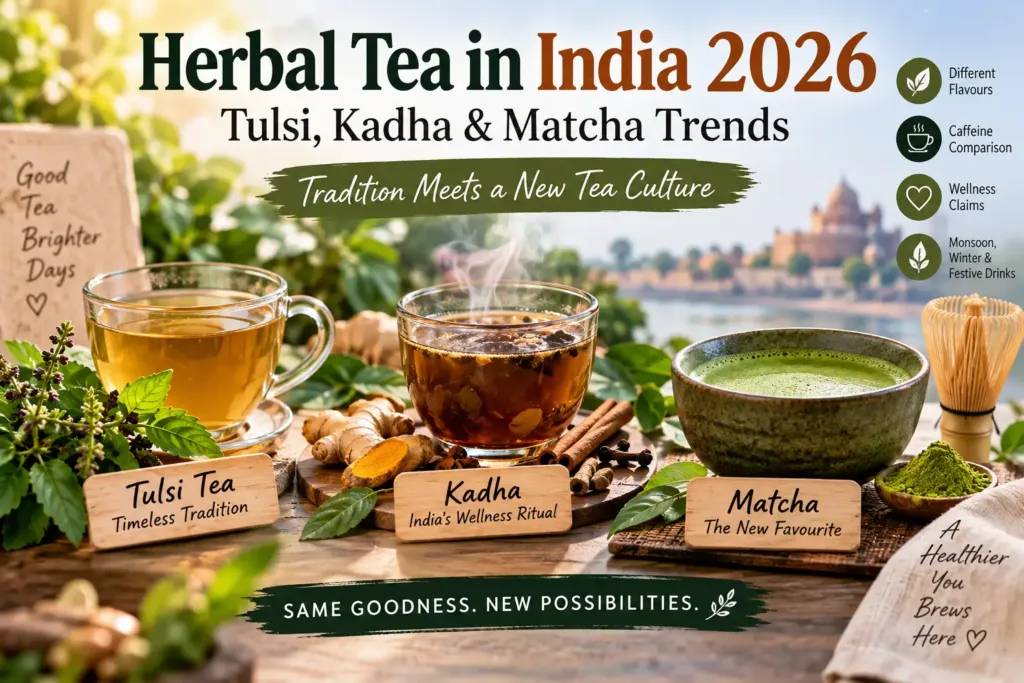
There is something interesting happening to the humble Indian cup of tea.
For years, tea in India was a fairly predictable ritual. Chai in the morning, another cup in the afternoon, and perhaps ginger tea when the weather turned cold or the rain arrived.
But the conversation around tea is changing.
Today, people are asking different questions. What exactly is in my tea? Does it contain caffeine? Is it actually useful, or is the packaging simply making a wellness promise? Should I try matcha? And what about the traditional tulsi tea or kadha that Indian households have known for generations?
In 2026, these questions are bringing traditional Indian herbal drinks and modern global beverages into the same conversation.
Google India’s September 2026 beverage trends report highlighted a sharp rise in interest around matcha in India. Searches for “how to make matcha” increased by 1,300% year over year, while searches related to “matcha health” increased by 1,000%. People were also increasingly searching about matcha’s caffeine content and comparing matcha with coffee.
But there is another side to this trend.
India already has a long tradition of herbal beverages.
Tulsi, ginger, spices and other botanical ingredients have been part of Indian food and household traditions for generations.
So perhaps the real story isn’t matcha versus herbal tea.
It is about how Indian consumers are becoming more curious about what goes into their cup.
Table of Contents
What Is Herbal Tea?
Before discussing benefits or trends, it helps to understand what herbal tea actually means.
Traditional tea is produced from the Camellia sinensis plant. Green tea, black tea and matcha all come from this plant.
Herbal teas are different.
They are generally infusions prepared using ingredients such as:
- Herbs
- Flowers
- Roots
- Seeds
- Spices
- Leaves from plants other than Camellia sinensis
Tulsi infusion, ginger infusion and many traditional spice-based drinks fall into this broader category.
This distinction is particularly important when discussing caffeine.
Many simple herbal infusions are naturally caffeine-free, while green tea, black tea and matcha naturally contain caffeine.
However, not every product labelled “herbal tea” is automatically caffeine-free. Some commercial blends combine herbs with green tea, black tea or matcha.
That is why the ingredient list is often more informative than the name printed on the front of the package.
Why Is Herbal Tea Becoming Popular in India?
The growing interest in herbal tea isn’t happening in isolation.
Consumers are becoming increasingly interested in beverages that fit particular lifestyles and routines.
Some people want caffeine-free drinks.
Others want alternatives to sugary beverages.
Some enjoy traditional ingredients such as tulsi and ginger, while others are experimenting with global trends such as matcha and hojicha.
There is also growing curiosity around the idea of “functional beverages” — drinks that are marketed around specific wellness properties.
This has created an interesting situation.
A traditional Indian kadha can now appear alongside matcha latte recipes and imported wellness drinks in the same online search journey.
The ingredients may be different, but the consumer question is often similar:
“What am I actually drinking, and what should I expect from it?”
Tulsi Tea: An Old Indian Favourite in a New Wellness Conversation
Tulsi has a unique place in Indian culture.
It has been used traditionally for generations and remains one of the most familiar herbs associated with Indian household wellness practices.
Tulsi is also being studied scientifically.
A systematic review examining human studies on tulsi identified research involving areas such as metabolic health, immunity and neurocognitive outcomes. However, the researchers also highlighted limitations in the available evidence, including differences in preparations, doses and study quality.
This distinction is important.
Traditional use and scientific evidence are not the same thing.
The fact that an herb has been traditionally used for a particular purpose does not automatically prove every modern health claim made about it.
For everyday consumption, tulsi can be viewed as a herbal ingredient and beverage option rather than automatically treating it as a medicine.
Does Tulsi Tea Contain Caffeine?
Pure tulsi does not naturally contain caffeine.
This makes a simple tulsi infusion different from conventional tea made from Camellia sinensis.
However, packaged tea blends can contain several ingredients.
A tulsi blend containing green tea, black tea or matcha will have a different caffeine profile from a product made entirely from tulsi.
If caffeine matters to you, always check the ingredient list.
What Is Kadha?
Kadha is one of India’s most recognisable traditional herbal preparations.
But there is no single universal kadha recipe.
Different households and regions may use different combinations of ingredients.
A preparation may include ingredients such as:
- Tulsi
- Ginger
- Black pepper
- Cinnamon
- Cloves
- Cardamom
- Turmeric
The exact recipe, quantity and preparation method can vary significantly.
This is why broad claims about “what kadha does” should be treated carefully.
A kadha made primarily with ginger and tulsi is not necessarily equivalent to a concentrated commercial herbal formulation containing numerous extracts.
The ingredients and quantities matter.
Is Kadha the Same as Herbal Tea?
Kadha and herbal tea overlap, but they are not necessarily identical.
Herbal tea is a broad category of plant-based infusions.
Kadha is a traditional Indian preparation that generally involves simmering or preparing herbs and spices in water.
The terminology can vary between households, brands and regions.
What matters most is understanding what ingredients are actually being used.
Why Is Matcha Suddenly Everywhere in India?
Matcha has existed for centuries, but its popularity in India has entered a new phase.
Google India’s September 2026 beverage trends report showed a significant increase in Indian searches around matcha.
Searches for “how to make matcha” grew 1,300% year over year, while “matcha health” searches increased 1,000%.
People were also searching for:
- Matcha caffeine
- Matcha versus coffee
- Matcha protein
- Matcha recipes
- Matcha preparation
- Matcha accessories
This tells us something interesting.
People aren’t only discovering matcha as a drink.
They are exploring an entire matcha ritual.
They want to know how to prepare it, what equipment to use, what it tastes like and how it fits into their existing beverage habits.
Matcha vs Herbal Tea: What’s the Difference?
Matcha and herbal tea are sometimes compared as though they are interchangeable.
They aren’t.
| Drink | Main ingredient/source | Caffeine | Typical character |
|---|---|---|---|
| Tulsi infusion | Tulsi leaves | Naturally caffeine-free | Herbal and aromatic |
| Ginger infusion | Ginger root | Naturally caffeine-free | Warm and spicy |
| Kadha | Herbs and spices | Depends on ingredients | Strong and spiced |
| Green tea | Camellia sinensis | Contains caffeine | Fresh and vegetal |
| Matcha | Powdered green tea | Contains caffeine | Rich and umami |
| Hojicha | Roasted green tea | Contains caffeine | Toasty and roasted |
So rather than asking which drink is universally “better,” it makes more sense to ask what you want from your beverage.
If you want a caffeine-free evening drink, a simple herbal infusion may suit you.
If you’re looking for a caffeinated beverage, matcha belongs to a different category.
If you’re choosing based purely on flavour, then taste may be the most important factor.
Not every beverage needs to be turned into a health competition.
The Problem With the Word “Functional”
The word functional has become increasingly common in the beverage industry.
You’ll find teas and drinks marketed around claims involving:
- Digestion
- Immunity
- Detox
- Metabolism
- Relaxation
- Sleep
- Energy
- Weight management
The problem is that the word “functional” itself doesn’t establish that a product will deliver a particular health outcome.
Individual herbs may have scientific research behind them.
But research on an ingredient does not automatically prove that a particular commercial tea blend will produce the same result.
A review of herbal tea research found that, despite widespread traditional and commercial use, relatively few clinical studies had directly examined the efficacy and safety of herbal teas.
This is why wellness claims deserve a second look.
A marketing claim is not the same thing as clinical evidence.
How to Choose Herbal Tea in India
If you’re buying herbal tea, don’t choose it only because the front of the packet says “detox,” “natural” or “wellness.”
Turn the package around and check the details.
1. Read the Ingredient List
Look at what is actually inside the product.
If a product contains ten different ingredients, understand what those ingredients are rather than relying only on the product name.
2. Check the Caffeine Content
If you are sensitive to caffeine or prefer to avoid it in the evening, make sure your blend does not contain green tea, black tea or matcha.
3. Look at Added Sugar
A herbal drink can become a high-sugar beverage if large amounts of sugar or sweeteners are added.
4. Examine Wellness Claims
Ask what the claim is based on.
Is it traditional use?
Laboratory research?
Animal studies?
Human clinical research?
These forms of evidence are not interchangeable.
5. Consider Your Individual Situation
Herbs can interact with medicines and may not be appropriate for everyone in concentrated amounts.
People taking regular medication, pregnant or breastfeeding women, children and individuals with specific medical conditions should seek appropriate professional advice before using concentrated herbal preparations regularly.
Herbal Tea for Monsoon, Winter and Festive Seasons
One of the reasons herbal drinks work so naturally in India is our seasonal relationship with food and beverages.
During monsoon, warm ginger and tulsi infusions can become comforting additions to the evening routine.
During winter, stronger flavours such as ginger, cinnamon and cloves often become more appealing.
During festive periods, people may experiment with richer or sweeter herbal beverages.
But there is another reason these drinks remain popular.
They create a ritual.
The smell of ginger.
The warmth of a cup between your hands.
The process of preparing the drink.
The pause before taking the first sip.
These things don’t necessarily need a medical explanation.
Sometimes people choose a beverage simply because it fits the moment.
Is Herbal Tea Healthy?
The most honest answer is:
It depends on the ingredients, preparation, quantity and health claim being considered.
Some herbs have been investigated in scientific studies, while others have much less evidence behind them.
Even when research exists, it may involve a specific extract, dose or preparation that isn’t equivalent to an ordinary cup of tea.
That is why it is better to think of herbal tea as a beverage category, not as a universal form of medicine.
A cup of herbal tea can be part of a balanced lifestyle without needing to promise that it will cure, prevent or treat a particular condition.
Herbal Tea vs Matcha: Which One Should You Choose?
There isn’t one answer that applies to everyone.
Choose according to what you’re actually looking for.
Choose a simple herbal infusion if:
- You prefer caffeine-free beverages.
- You enjoy herbal or spicy flavours.
- You want a simple evening drink.
- You like traditional Indian ingredients.
Consider matcha if:
- You enjoy green tea flavours.
- You want a caffeinated beverage.
- You are interested in the matcha preparation ritual.
- You enjoy experimenting with modern beverage recipes.
Consider traditional kadha if:
- You enjoy traditional Indian spice combinations.
- You want a warm, strongly flavoured herbal preparation.
- You understand the ingredients being used.
The important thing is not to treat any of these drinks as a miracle solution.
The Future of Herbal Tea in India
I don’t think India’s beverage future will involve one drink replacing another.
Chai isn’t going away because matcha is popular.
Tulsi isn’t becoming irrelevant because cafés are serving matcha.
And kadha isn’t outdated because consumers are experimenting with international beverages.
Instead, Indian consumers are becoming more experimental.
They are discovering ingredients from around the world while simultaneously rediscovering ingredients that have existed in Indian households for generations.
That combination is perhaps the most interesting part of the trend.
Global beverage culture is meeting India’s traditional herbal knowledge.
The result isn’t necessarily a replacement.
It is a larger beverage culture with more choices.
Final Thoughts
The most interesting herbal tea trend in India may not actually be about herbal tea.
It may be about curiosity.
Consumers are asking more questions about their drinks.
They want to know what’s inside them, whether they contain caffeine, what traditional ingredients mean and whether the wellness claims attached to them are supported by evidence.
Matcha has made this curiosity particularly visible.
But India’s traditional herbal drinks show that the country already had a rich beverage culture of its own.
Perhaps the best approach is somewhere in the middle:
Enjoy the tradition. Explore new trends. Read the label. Question exaggerated claims.
A good cup of tea doesn’t need to promise a miracle.
Sometimes, knowing exactly what’s in your cup is enough.
Frequently Asked Questions
What is herbal tea in India?
Herbal tea in India generally refers to plant-based infusions made using herbs, flowers, roots, spices, seeds or other botanical ingredients rather than traditional tea leaves from the Camellia sinensis plant.
Is tulsi tea caffeine-free?
Pure tulsi infusion is naturally caffeine-free. However, some packaged tulsi blends may contain green tea, black tea or other caffeinated ingredients, so checking the ingredient list is important.
Is kadha the same as herbal tea?
Kadha is a traditional Indian herbal preparation, while herbal tea is a broader category of plant-based infusions. Kadha recipes can vary significantly in ingredients and preparation.
Is matcha a herbal tea?
No. Matcha is powdered green tea made from the Camellia sinensis plant. Unlike many herbal infusions, matcha naturally contains caffeine.
What is the difference between herbal tea and matcha?
Herbal teas generally use herbs, roots, flowers or spices from plants other than Camellia sinensis. Matcha is made from powdered green tea leaves and contains caffeine.
Does herbal tea contain caffeine?
Many simple herbal infusions are naturally caffeine-free. However, some blends contain green tea, black tea or matcha and therefore contain caffeine.
Can you drink herbal tea every day?
Many people include simple herbal infusions in their daily beverage routine. However, the suitability of daily consumption depends on the ingredients, quantity, medications and individual circumstances.
How do I choose a good herbal tea?
Check the ingredient list, caffeine content, added sugar, preparation instructions and the evidence behind any health claims. Avoid choosing a product only because of words such as “detox” or “natural.”
Is herbal tea healthier than regular tea?
There is no universal answer. Herbal teas and conventional teas contain different ingredients and compounds. The appropriate choice depends on the specific beverage, caffeine preference, diet and individual circumstances.
Which is better: tulsi tea or matcha?
Tulsi tea and matcha are different beverages. Tulsi infusion is generally caffeine-free, while matcha contains caffeine. The choice depends on personal taste, caffeine preference and the type of beverage experience you want.
