
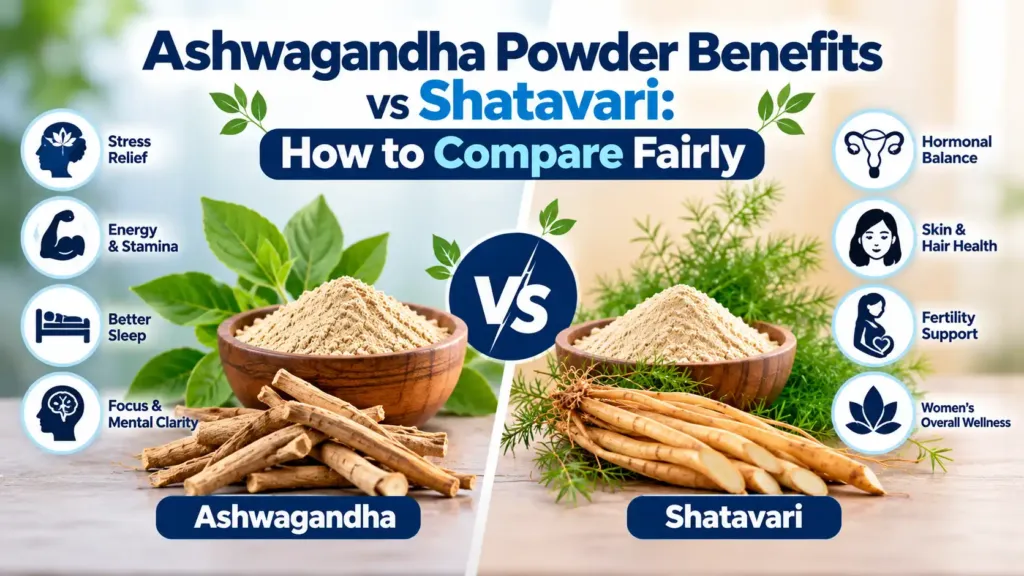
Comparing two powders by their benefit lists can mislead. I compare the evidence and the exact preparation instead.
Ashwagandha and shatavari come from different plants and are sold in different forms. “Powder” may mean whole dried root, while some labels use powder for an extract or a blend. That makes ingredient identity and preparation the starting point for any fair comparison.
Also read: Shatavari Powder Benefits: Read the Claims, Then Check the Product
Table of Contents
NCCIH says some ashwagandha preparations may help with stress and insomnia, but evidence for many other uses is insufficient; it also outlines potential side effects, interactions and groups who should avoid it. Shatavari research is developing and is product-specific. These summaries do not establish that one powder is right for everyone.
I would choose based on the health question, evidence for that formulation, and personal safety factors. If symptoms are persistent, get them assessed. If taking medicines or managing a condition, ask a clinician or pharmacist before starting either herb.
A closer look at ashwagandha powder benefits
The comparison should distinguish a root powder from an extract and avoid treating milligrams as equivalent.
Related: Shatavari: The Ayurvedic Queen of Herbs for Hormonal Balance
A fair comparison uses the same questions for both options: what plant is it, which plant part is used, what preparation is sold, and what human evidence supports the exact outcome? Traditional history can explain why people are interested, but it does not prove that one is stronger or better for everyone.
I would be cautious with tables that rank herbs without direct head-to-head research. A study on one preparation cannot automatically be carried over to another brand or format. Instead, define the concern first, check safety and medicine interactions, then discuss the specific product with a clinician. The most useful answer may be that the evidence is not strong enough to declare a winner.
My takeaway
My takeaway is not that one option wins for everybody. It is that a careful comparison starts with a defined goal, direct evidence and personal safety, then leaves room for uncertainty where research is still limited.
Related guides on Aarogya Jeevanam
- Shatavari Powder Ke Fayde: Powder Chunney Se Pehle Kya Dekhein
- Shatavari Ke Fayde: 7 Zaroori Baatein Jo Istemaal Se Pehle Samjhein
- Shatavari Benefits: What Is Traditional, and What Is Supported by Research?
Sources
- NCCIH: Ashwagandha — Usefulness and Safety
- Randomized study of shatavari root extract for menopausal symptoms (Frontiers in Reproductive Health, 2025)
- Review: Plant profile, phytochemistry and pharmacology of Asparagus racemosus
Disclaimer: This article is for general information only and is not medical advice. Please consult a qualified healthcare professional before starting any supplement.
Frequently asked questions about ashwagandha powder benefits
Is ashwagandha powder proven to help everyone with stress?
No. NCCIH describes evidence for some preparations as limited and notes that study results do not apply to every product or person.
Can I take ashwagandha and shatavari together?
Check with a healthcare professional first, especially if you take medicine or have a health condition.