
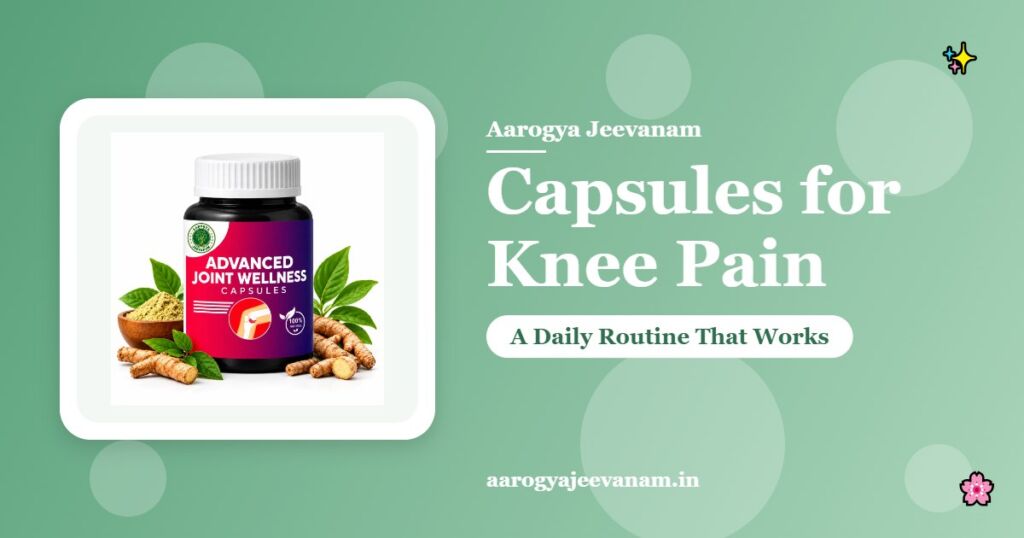
My neighbour, a retired schoolteacher, told me last winter that her knees felt like rusty hinges. She could manage the morning walk, but the stairs to her first-floor flat had become a daily negotiation. She asked me whether ayurvedic capsules for knee pain were worth trying. My honest answer was that capsules are only one piece of the puzzle. The routine around them decides most of the outcome.
This article walks through that routine. It is written for adults who want practical steps and a clear sense of when to stop self-care and see a doctor. It is not medical advice, and it does not replace an examination.
Table of Contents
Know the warning signs first
Before any herb or capsule, I want readers to check for red flags. Knee pain that follows a fall, a twisting injury, or a sudden swelling needs prompt medical care. So does pain with redness, warmth, fever, or a knee that locks or gives way. Night pain that wakes you, or pain that is getting steadily worse over weeks, also deserves a doctor’s review. Ayurvedic support is meant for ongoing stiffness and general joint comfort, not for these situations.
Morning and evening habits I recommend
Most of the people I speak to notice the worst stiffness after waking. A gentle start helps. Sit on the edge of the bed, move your ankles in small circles for a minute, then slowly straighten each knee ten times. Take a warm shower or use a warm towel before you stand up. In the evening, a short walk on flat ground is usually kinder to the knees than a long session on hard stairs.
Weight matters too. Even a small reduction in body weight takes pressure off the knee joint with every step. I do not mean crash dieting. I mean regular meals with enough protein, plenty of vegetables, and fewer late-night snacks.
Where ayurvedic capsules fit in
A joint capsule should sit alongside these habits. In practice, the herbs most often discussed for joint comfort include turmeric, shallaki (Boswellia serrata), and guggal, all of which appear in traditional formulas. The label I read for the Advanced Joint Wellness Capsules directs one capsule twice daily after meals with lukewarm water. It advises using the product regularly for two to three months before judging the result. That timeline matters. If you stop after one week, you have tested nothing.
Advanced Joint Wellness Capsules
30 capsules | Rs 1,199 Rs 2,199
Designed for daily joint comfort. Take 1 capsule twice daily after meals.
Keeping a simple knee diary
My best advice is boring but effective. Each morning, write down three things: how stiff your knees felt on waking, how far you walked the day before, and whether you took your capsules. After two weeks you will see patterns. Perhaps your knees are worse after long train journeys, or better on days you walk. The diary also helps your doctor, because it turns a vague complaint into specific information.
Why knees hurt differently in different people
Two people with the same complaint can have very different knees. One may feel stiffness only after sitting, while another feels a dull ache on the inner side when climbing stairs. A large part of my advice to readers is to describe the pattern clearly. Is the pain worse in the morning, after walking, or at night? Does it sit at the front, inside or outside of the knee? Does the knee feel unstable? These details help a doctor decide what to check, and they help you judge whether a capsule or a routine is making a difference. Many people look for a single answer, but a precise description is often the most useful first step.
I also remind readers that weight-bearing exercise is not the enemy of healthy knees. Gentle strengthening of the thigh muscles, such as slow sit-to-stand movements from a chair, supports the joint in daily life. Start with a few repetitions, stop if sharp pain appears, and build up gradually. A physiotherapist can show you the right version for your knees.
Walking and stairs: small changes that add up
I notice that most people with knee stiffness change their daily movement without realising it. They take the lift instead of the stairs for a week, skip the evening walk, and then wonder why the knees feel worse. A better approach is to keep movement within a comfortable range every day. If stairs are painful, try going up with the stronger leg first and down with the weaker leg, holding a rail. Choose softer surfaces for walks where possible, and use a cushioned pair of shoes. Carry shopping in both hands to keep the load balanced. None of these tips are dramatic, but together they reduce the daily strain on the joint.
Frequently asked questions
Why do my knees feel worse on cold mornings?
Cold tightens soft tissues and makes the joint fluid feel thicker, so stiffness is common after waking. Warm water, a slow start and gentle movement usually help, but persistent or swollen knees need a doctor’s review.
How do I tell normal stiffness from something serious?
Normal winter stiffness usually eases within 30 to 60 minutes and does not come with heat, redness or fever. If the knee is hot, swollen, very painful, or you cannot bear weight, see a doctor promptly.
Can I take knee capsules if I already take painkillers?
Ask your doctor before combining them. Some herbs and some painkillers can interact, and you should never stop a prescribed medicine without advice. Tell your doctor exactly what you take, including supplements.
Is it safe to walk if my knees hurt?
Gentle walking on flat ground is usually a good idea for most people with stiff knees, but pain that gets sharper or swelling that appears after walking is a sign to slow down and speak to a doctor.
Should I use a knee cap or brace?
A brace can help some people feel more stable, especially on long walks. A physiotherapist can recommend the right type. Do not use a brace for days on end without checking how it affects your muscles.
Do I need to avoid all sweets and fried food for knee comfort?
No, you do not need extreme rules. I suggest balance: more vegetables and whole foods, fewer heavy fried meals, and water through the day. Consistency beats perfection.
What I would do in your place
Start with the warning signs, then build a morning and evening routine you can keep for three months. Add a joint capsule only if your doctor agrees and you can take it every day. Keep the diary, and review it on a fixed date. If your knees are not better after that period, the right next step is a conversation with a doctor, not a bigger dose.
Disclaimer: This article is for general information and is not medical advice. These statements have not been evaluated by the Food Safety and Standards Authority of India. The product is not intended to diagnose, treat, cure or prevent any disease. Speak to a doctor for knee pain that is severe, persistent, injury-related, or accompanied by swelling or fever.