
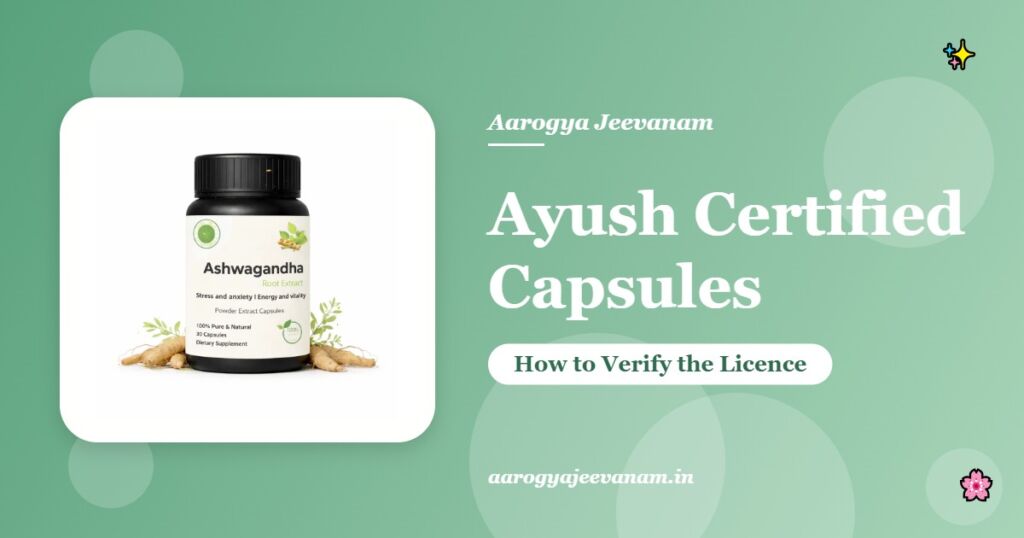
Almost every listing for ayush certified herbal capsules India says “Ayush approved” or “GMP certified” somewhere. These words are used so loosely that they mean little to buyers now. Here I explain what an Ayush licence and GMP actually mean, how to verify them in a few minutes, which red flags should make you pause, and how Aarogya Jeevanam presents its own certifications so you can hold us to the same standard.
Table of Contents
What an Ayush Licence Really Means
In India, Ayurvedic medicines are made under a manufacturing licence issued by the State Licensing Authority for Ayurveda, Siddha and Unani drugs, under the Drugs and Cosmetics Act, 1940 and its Rules. People commonly call this an “Ayush licence”. It tells you that a specific manufacturing unit is legally permitted to produce specific Ayurvedic products.
What I want every buyer to understand: a licence is legal permission to manufacture. It is not a government stamp saying a product works. It is the minimum you should expect, not a bonus feature.
Some herbal capsules are sold under a food or nutraceutical licence instead, which is a different regulatory route. Know which one your product follows; the label should make it clear.
What GMP Certification Means for Ayurvedic Capsules
GMP stands for Good Manufacturing Practices. For Ayurvedic medicines, these requirements are laid out in Schedule T of the Drugs and Cosmetics Rules. In simple terms, GMP covers the factory side of quality: clean premises, controlled raw material handling, proper storage, documented processes, batch records and quality checks.
GMP is about how a product is made, not what it does. A GMP facility should be able to trace every batch back to its raw materials and records, which is what makes a batch number meaningful.
How to Verify Ayush Certified Herbal Capsules Yourself
Pick up the bottle, or zoom into the label photos on the product page, and check these points.
- Manufacturing licence number: usually printed as “Mfg. Lic. No.” or similar. If it is missing, ask why.
- Manufacturer name and full address: a real factory address, not just a brand name or a website.
- Batch number, manufacturing date and expiry date: all three should be clearly printed.
- Ingredients with botanical names: for example, our Barbed Grass label lists Imperata cylindrica. Latin names remove confusion between similar common names.
- Category on the label: whether it is labelled as an Ayurvedic proprietary medicine or as a food or nutraceutical product.
- Lab report or COA: a Certificate of Analysis is a batch-level test report. Ask the seller for the report that matches your batch number.
If a seller answers all this quickly, good sign. If they get vague, thoda dhyan rakhein.
Red Flags: Genuine Label vs Doubtful Label
This is the quick comparison I use myself.
| What to check | Reassuring sign | Red flag |
|---|---|---|
| Licence number | Clearly printed on label | Missing, blurred or “available on request” only |
| Manufacturer address | Full factory address | Only a brand name or email |
| Batch and expiry | Printed on every pack | Missing or hand-written sticker |
| Claims | “Supports”, “traditionally used” | “Cures”, “guaranteed”, “no side effects”, “results in 7 days” |
| Lab report | Shared for your batch on request | Refused, or one generic report for every batch |
| Ingredients | Herb names with botanical names | Vague “secret herbal formula” |
The claims row matters. Indian law does not allow disease-cure or magic-remedy claims in advertising, so a product promising a cure is a red flag even if its licence looks fine.
How Aarogya Jeevanam Presents Its Certifications
I would rather you verify us than simply trust us. Aarogya Jeevanam states that its products are Ayush and GMP certified and third-party lab tested. Here is how you can check that for yourself:
- Look at the label on your bottle, or the label images on the product page, for the licence number, manufacturer details, batch number and expiry.
- Contact the team and ask for the batch certificate or lab report for the batch you received or are about to buy.
- Check the ingredient list on the label. Please do not assume a product contains anything beyond what the label states.
For example, you can apply this checklist to our Ashwagandha Herbal Capsules (30 veg capsules, ₹599, MRP ₹1,099), our Amla Herbal Capsules (30 veg capsules, ₹549, MRP ₹999) or our Brahmi Herbal Capsules (30 veg capsules, ₹599, MRP ₹1,099). Prices as checked on 21 Nov 2026; check the product page for the current price.
Current offers: code NEW10 gives 10% off your first order, prepaid orders get an extra 5% off, shipping is free above ₹499, and Cash on Delivery is available. For a first-time buyer who wants to inspect the bottle before paying, COD is a sahi choice.
Who Should Be Careful With Any Herbal Capsule
Certification tells you about manufacturing quality, not whether a herb suits your body. Please consult a qualified doctor or Ayurvedic practitioner first if you are:
- Pregnant or breastfeeding
- Buying for a child
- Taking prescription medicines, especially blood thinners, thyroid, blood pressure, blood sugar or sedative medicines, as some herbs may interact with them
- Living with a chronic condition such as liver or kidney disease, or an autoimmune condition
- Due for surgery; most practitioners advise stopping herbal supplements beforehand
- Prone to allergies, or allergic to any herb or capsule ingredient listed on the label
FAQ
Where exactly is the Ayush licence number printed on a capsule bottle?
It is usually on the side or back label, near the manufacturer’s name and address, often marked “Mfg. Lic. No.” If the product page photos do not show it clearly, ask the seller for a clear label image before you order.
Is “GMP certified” the same thing as “Ayush licensed”?
No. The licence is permission to manufacture a product legally. GMP is about the standards of the factory and its processes. A good Ayurvedic manufacturer should have both.
Does an Ayush licence prove that a herbal capsule works?
No. A licence and GMP relate to legal manufacturing and quality systems. They do not prove any health outcome, which is why honest brands use words like “supports” rather than “cures”.
What should I do if my herbal capsules arrive without a batch number?
Do not start using them. Share a label photo with the seller and ask for an explanation or replacement. Without a batch number, the product cannot be traced or matched to a lab report.
Can I ask for a lab report before I place an order?
Yes, and I encourage it. Ask Aarogya Jeevanam for the batch certificate or lab report.
This article is for general information and consumer awareness only and is not legal or medical advice. Herbal capsules may support general wellbeing; they are not intended to diagnose, treat, cure or prevent any disease. Regulatory details can change, so check current rules with official sources if you need certainty. Read the label and consult a qualified doctor or Ayurvedic practitioner before starting any supplement, especially if you are pregnant, breastfeeding, taking medicines or managing a health condition.