
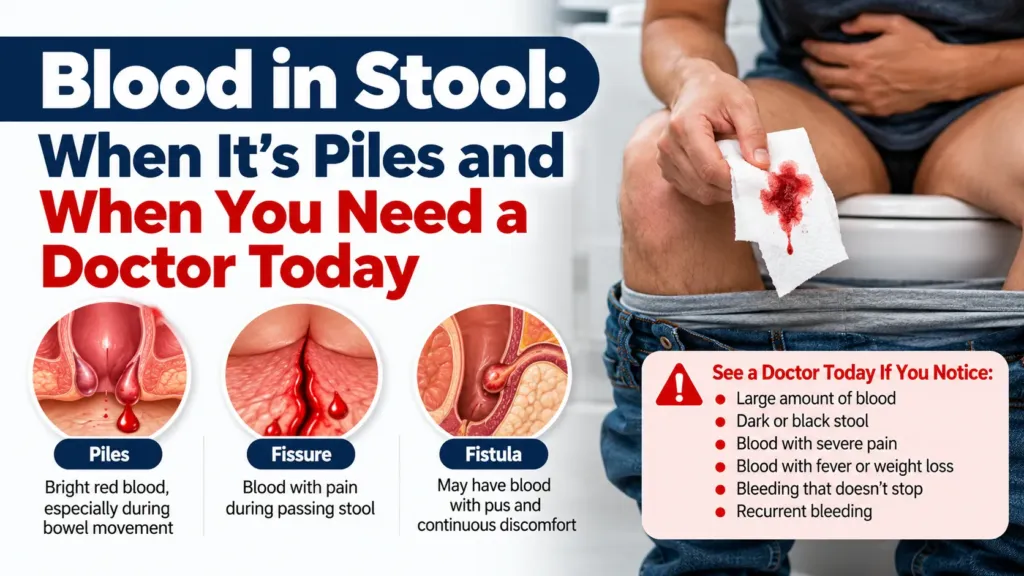
Few things are as scary as looking down and seeing red in the toilet. Your mind races. Is it serious? Is it cancer?
Take a breath. In most cases, bright red blood after passing stool comes from piles or a small fissure. But “most cases” is not “all cases.” This guide helps you understand what you’re seeing and when to stop waiting.
Why piles bleed
Piles are swollen blood vessels close to the surface (what piles is). When hard stool passes over them, or you strain, the thin covering can break and bleed. In India this is often called khooni bawaseer.
Typical bleeding from piles:
- Is bright red, not dark
- Appears on toilet paper, as drops in the pan, or as a streak on the stool
- Happens during or right after passing stool
- Is usually painless (internal piles)
- Stops on its own within minutes
What the colour of blood tells you
| What you see | What it may mean |
|---|---|
| Bright red drops or streaks | Piles or fissure, near the anus |
| Bright red with sharp pain | Likely a fissure (compare here) |
| Dark red, mixed into stool | Bleeding higher in the bowel; needs a doctor |
| Black, sticky, tar-like stool | Bleeding in the stomach or upper gut; see a doctor urgently |
Note: iron tablets and some foods (beetroot, black grapes) can change stool colour. If you’re unsure, get it checked.
Red-flag signs: see a doctor promptly
Don’t self-treat if you have any of these:
- Heavy bleeding, clots, or bleeding that won’t stop
- Black or maroon stool
- Dizziness, weakness, breathlessness, or pale skin (signs of anaemia)
- Unexplained weight loss or loss of appetite
- A change in bowel habits lasting more than 3 weeks
- Bleeding for the first time after age 40
- Family history of bowel cancer
- Fever or severe belly pain with bleeding
These don’t mean you have something serious. They mean a doctor should look, usually with a simple exam or a colonoscopy.
How to calm bleeding piles at home
If your bleeding is light, bright red and you have no red flags:
- Soften your stool. Fibre, 8 to 10 glasses of water and a spoon of isabgol at night.
- Never strain. Get up if nothing happens in a few minutes.
- Cut toilet time. No phone, 5 minutes maximum.
- Use cool or warm water to clean instead of rough paper.
- Take a sitz bath to soothe the area.
In Ayurveda, bleeding piles is called Raktaja Arsha and is linked to aggravated Pitta. Cooling foods like buttermilk, coconut water and amla are traditionally advised, along with avoiding very spicy, oily food.
Is it internal or external piles?
Internal piles usually bleed without pain. External piles hurt more and bleed less, unless a clot forms. See internal vs external piles. For other early signs, read पाइल्स के लक्षण.
Frequently Asked Questions
Is bleeding in piles normal?
Light, bright red, painless bleeding is a common sign of internal piles. It is common, but you should still get it checked once by a doctor.
How do I stop bleeding piles?
Keep stool soft with fibre and water, avoid straining, limit toilet time and take sitz baths. If bleeding is heavy or doesn’t stop, see a doctor.
Can bleeding piles cause weakness?
Yes. Long-term bleeding can cause anaemia, leading to tiredness, breathlessness and pale skin. A blood test can check this.
How do I know if blood in stool is serious?
Dark or black stool, heavy bleeding, weight loss, a lasting change in bowel habits or first-time bleeding after 40 all need a doctor’s check.
Which doctor should I see for bleeding piles?
A general surgeon, proctologist or gastroenterologist. An Ayurvedic Shalya Tantra specialist also treats anorectal conditions.
About the author: Deepak Sagar is an Ayurvedic wellness content writer with Aarogya Jeevanam and over 6 years of experience writing on digestive health and holistic living.
Disclaimer: This article is for general information only and is not a substitute for medical advice. Please consult a qualified doctor for diagnosis and treatment.