
Sunscreen is one of the most talked-about — and most misunderstood — products in skincare. Does it actually prevent tanning, or is that just marketing? Let’s separate the myths from the dermatologist-backed facts.
Table of Contents
Myth 1: Sunscreen Blocks 100% of Tanning
Fact: No sunscreen blocks all UV rays. Even SPF 50 only filters out about 98% of UVB rays, and some UV still reaches your skin. That said, consistent use dramatically reduces how much tan you develop over time compared to going without protection at all.
Myth 2: Higher SPF Means You Don’t Need to Reapply
Fact: SPF number relates to the strength of protection per application, not how long it lasts. Regardless of SPF level, sunscreen breaks down with sweat, water, and time — dermatologists recommend reapplying every 2-3 hours for continued protection.
Myth 3: Sunscreen Removes Tan You Already Have
Fact: Sunscreen is purely preventive — it stops new tan from forming but does nothing to lighten existing pigmentation. If you already have tan, you’ll need a separate de-tan product or routine alongside daily sunscreen.
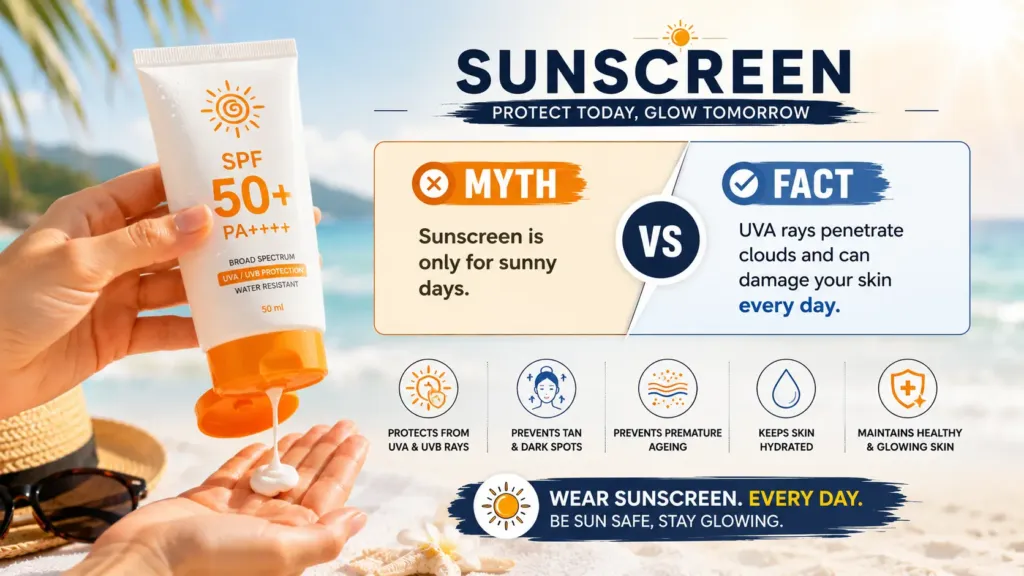
Myth 4: You Don’t Need Sunscreen on Cloudy Days
Fact: Up to 80% of UV rays pass through cloud cover, which means you can still tan (or burn) on an overcast day. Dermatologists recommend daily sunscreen regardless of visible sunshine.
Myth 5: Indoor Days Don’t Need Sunscreen
Fact: UVA rays — the type most associated with tanning and premature aging — can penetrate window glass. If you sit near a window for extended periods, some sunscreen protection is still worthwhile.
How to Choose the Right Sunscreen to Prevent Tanning
• Look for “broad-spectrum” protection, which covers both UVA and UVB rays.
• Choose SPF 30-50 for daily use, and SPF 50+ for extended outdoor exposure.
• Check for a PA+++ or PA++++ rating, which indicates strong UVA protection specifically.
• Pick a texture suited to your skin type — gel or matte-finish for oily skin, cream-based for dry skin.
• Reapply every 2-3 hours, and immediately after swimming or heavy sweating.
Sunscreen won’t make you completely tan-proof, but it’s the single most effective tool for preventing new tan and long-term sun damage. Pair it with a de-tan routine for existing tan, and you’ll get the best of both prevention and treatment.
FAQs
Can sunscreen completely stop tanning?
No sunscreen blocks 100% of UV rays, but a broad-spectrum SPF 30-50 applied correctly and reapplied every 2-3 hours significantly reduces tanning and sun damage.
What SPF is best to prevent tanning?
SPF 30 to 50 with broad-spectrum (UVA+UVB) protection and PA+++ rating is ideal for daily use in sunny or humid climates.
Does sunscreen remove existing tan?
No, sunscreen only prevents new tanning — it doesn’t lighten tan you already have. You’ll need a de-tan product alongside it for existing tan.
Should I reapply sunscreen to avoid tan?
Yes, reapplying every 2-3 hours, especially after sweating or swimming, is essential since sunscreen effectiveness wears off over time.
Can I skip sunscreen on cloudy days?
No, up to 80% of UV rays pass through clouds, so skipping sunscreen on overcast days still leaves skin exposed to tanning and damage.
