
Table of Contents
- The Product in Brief
- What Flaxseed Provides
- What the Label Says, and What It Does Not
- Capsule or Food: Which Is Better Value?
- Whole Seed or Ground: Why It Matters
- How to Add Flaxseed to Everyday Meals
- Reading the Omega-3 Claim Carefully
- Safety: Who Should Be Careful
- Frequently Asked Questions
- Our Verdict
People searching for flax seed capsules price in India usually want to know two things: whether a capsule is worth the money compared with simply eating flaxseed, and what the capsule actually contains. This guide compares the price of one specific product, the Flax Seed Capsules from Aarogya Jeevanam, with the nutritional facts about flaxseed itself.
Quick answer
Flax Seed Capsules (30 veg capsules) are listed at ₹549, against an MRP of ₹999. That is about ₹18.30 per capsule. Flaxseed is a plant source of alpha-linolenic acid (ALA), an omega-3 fatty acid. The label does not give the amount of flax extract per capsule, so price alone cannot show value.
01The Product in Brief
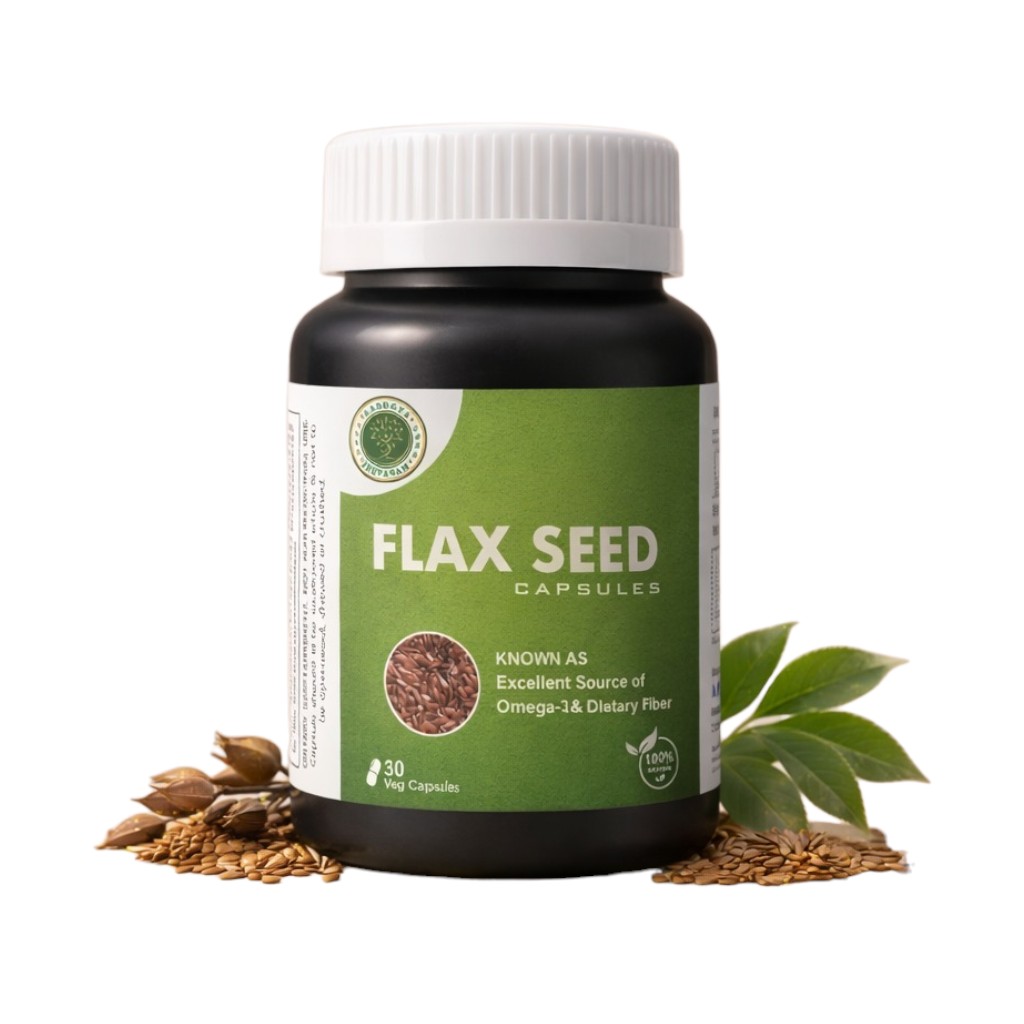
Flax Seed Capsules
30 Veg Capsules · Flax seed extract
- Vegetarian capsules · Net weight 40 g
- Prepaid orders: about ₹521.55
- Cash on delivery available
02What Flaxseed Provides
Flaxseed is best known for two things. The first is alpha-linolenic acid (ALA), a plant omega-3 fatty acid. The second is dietary fibre, which includes both soluble and insoluble types. Flaxseed also contains lignans, plant compounds that are studied for their antioxidant activity. Whole or ground flaxseed in food is the most common way to take it.
One point is often missed. The body converts only a small share of ALA into the longer-chain omega-3s, EPA and DHA, that are found in fish oil. This means flaxseed is a useful source of ALA but not a direct substitute for fish oil. Capsules do not change this conversion.
03What the Label Says, and What It Does Not
The product page makes three benefit statements, and they are quoted here as the seller’s claims, not as proven outcomes:
- “Supports balanced cardiovascular wellness”
- “Promotes healthy digestion and regularity”
- “Supports natural glow and strength”
Flaxseed’s fibre content can support regular bowel habits for many people, and omega-3 intake from food is linked with heart health in general nutrition guidance. These are general observations about the food. They are not evidence that this specific capsule produces the same effect, and the page does not cite any study on the product.
The ingredient list shows only “Flax Seed Extract”, with no amount per capsule. The page also gives two dosing directions: one capsule twice daily after meals, and one capsule daily after any meal. Ask the seller which is correct before starting.
Certifications listed on the page include “Ayush & GMP Certified” and “Third-Party Lab Tested”. The page does not name the certifying body or give a test report number. Ask for the certificate before you rely on it.
04Capsule or Food: Which Is Better Value?
Whole flaxseed is inexpensive. Two tablespoons of ground flaxseed mixed into dal, curd, a smoothie or roti gives you ALA and fibre in a form you can see and measure. A capsule costs more per gram of usable material, and its extract amount is not printed on the label.
A capsule may suit you if you dislike the taste or texture of flaxseed, if you travel, or if you prefer a fixed serving. If you choose the capsule for convenience, that is a reasonable reason. If you choose it for a specific health result, the label does not support that promise, and food is the better-documented route.
05Whole Seed or Ground: Why It Matters
If you choose to eat flaxseed in food, the form matters. Whole flaxseeds have a hard outer shell, and much of the seed can pass through the digestive system without being broken down. Grinding the seed just before use makes its oil and fibre more accessible. For this reason, nutrition guidance usually recommends ground flaxseed rather than whole seeds. Ground flaxseed goes rancid faster than whole seed, so store it in an airtight container in the refrigerator and use it within a short period.
Flax capsules avoid the grinding and storage question, but they bring their own uncertainty. You cannot tell from the label how much ALA each capsule holds, and you cannot see whether the seed was ground fresh or stored for a long time before encapsulation. These are fair questions to put to any seller.
06How to Add Flaxseed to Everyday Meals
For people who prefer food, the simplest approach is to stir one to two tablespoons of ground flaxseed into curd, dal, a vegetable dish, dough for chapatis, or a smoothie. Start with a small amount and increase gradually, and drink plenty of water through the day, because a sudden jump in fibre can cause bloating or constipation. Stop and seek advice if you have persistent stomach pain or difficulty passing stools.
07Reading the Omega-3 Claim Carefully
Many buyers read “omega-3” and assume the product works like fish oil. The distinction is worth remembering. Fish oil contains EPA and DHA directly. Flaxseed contains ALA, which the body can convert into EPA and DHA, but the conversion is limited. A product built on flaxseed therefore supplies a different fatty acid profile from fish oil, and the two are not interchangeable. If you are considering omega-3 for a specific reason, discuss the choice with your doctor rather than assuming one can replace the other.
08Safety: Who Should Be Careful
- Pregnancy and breastfeeding: Flaxseed is common in food, but concentrated capsules are different. Ask your doctor first.
- Blood sugar and blood pressure medicines: Fibre can change how some medicines are absorbed or how well they work. Speak to your doctor if you take these medicines, and time doses with advice.
- Blood thinners: Omega-3 fatty acids can affect clotting in some people. Check with your doctor if you take anticoagulants or have a bleeding disorder.
- Digestive conditions: If you have a bowel obstruction, a narrowing of the gut, or a history of such problems, do not use flax products without medical advice.
- Water: Take capsules with enough water. Fibre-rich products taken without fluid can cause discomfort.
- Allergic reactions: Stop and seek advice if you notice rash, itching or swelling.
09Frequently Asked Questions
What is the flax seed capsules price in India?
The listed price for Flax Seed Capsules (30 veg capsules) is ₹549, with an MRP of ₹999. Prepaid orders have an extra 5% off.
Do flax seed capsules contain omega-3?
Flaxseed contains ALA, which is a plant omega-3. The label does not list the amount of ALA per capsule, so you cannot calculate how much you are getting.
Are flaxseed capsules better than eating flaxseed?
Not necessarily. Food gives you a clear, measurable amount and costs less. Capsules are a convenience choice.
How long should I take it?
The page recommends at least eight to twelve weeks of consistent use, while also mentioning energy changes within seven to ten days. These two statements differ, so check with the seller and follow your healthcare professional’s guidance on duration.
Does flaxseed cure any disease?
No. Flaxseed is a food that contains fibre and omega-3 fats. It is not a treatment or cure for any disease.
10Our Verdict
At ₹549 for 30 capsules, the price is in line with other single-herb capsules sold by this brand. As a value purchase, the case is weaker than buying ground flaxseed for your meals, because the label does not show how much ALA or fibre each capsule contains. If you want the capsule, check the dosage, ask for the certificate and keep up with your doctor’s advice if you take medicines.
Disclaimer: These products are not intended to diagnose, treat, cure or prevent any disease. This article is general information and is not medical advice. Results may vary from person to person. Consult a qualified healthcare professional before use, especially if you are pregnant, breastfeeding, taking medication or managing a medical condition. Keep out of reach of children.