
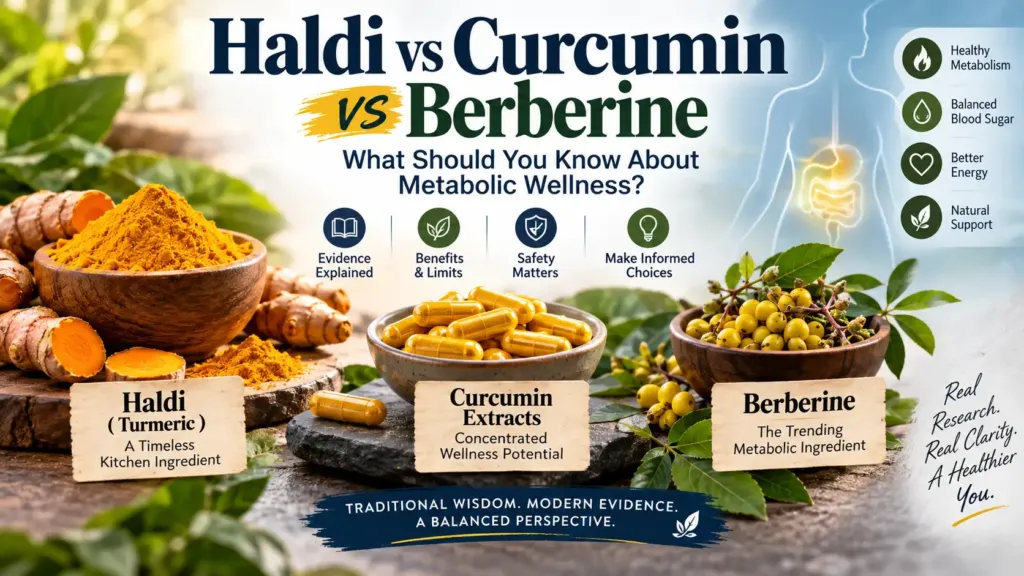
Turmeric has never really needed an introduction in India.
It is in our kitchens, our spice boxes, our traditional recipes and, for many families, in everyday food habits. But somewhere along the way, one familiar kitchen ingredient acquired a much more technical identity.
Curcumin.
Then came capsules, concentrated extracts, enhanced-absorption formulas and increasingly ambitious wellness claims.
At the same time, another botanical compound began attracting attention: berberine.
Today, both ingredients appear frequently in conversations around blood sugar, metabolism, weight management and “metabolic health.”
That creates an important question:
Is eating turmeric the same as taking curcumin? And is berberine simply another version of Ayurvedic metabolic wellness?
The short answer is no.
The longer answer is much more interesting.
Research suggests that curcumin and berberine may influence several metabolic markers, but the evidence varies by formulation, dose, population and outcome. Recent reviews also highlight an important reality that is often missing from supplement marketing: promising research does not automatically turn a concentrated botanical extract into a universal health solution.
Table of Contents
Why Metabolic Wellness Has Become a Bigger Conversation
“Metabolism” sounds like a single process.
It isn’t.
The body’s metabolic system involves interconnected processes related to energy use, blood glucose regulation, insulin sensitivity, lipids and many other physiological functions.
That makes metabolic wellness a much broader subject than simply asking:
“How can I lose weight?”
Yet weight-loss marketing has increasingly pulled ingredients such as berberine and curcumin into the same conversation.
This is where the language can become misleading.
A supplement may be marketed as a “metabolism booster,” while the actual research may have examined a specific biomarker in people with a particular health condition.
Those are not necessarily the same thing.
For me, this is the most useful starting point:
Don’t judge a metabolic ingredient by the size of its marketing claim. Look at the actual outcome researchers studied.
Haldi and Curcumin Are Related — But They Are Not Identical
Turmeric is the spice we commonly call haldi, obtained from the rhizome of Curcuma longa.
Curcumin is one of the major compounds found in turmeric.
That distinction matters.
When you add turmeric to dal, vegetables or another dish, you’re consuming a whole food ingredient containing a mixture of compounds.
A curcumin supplement, on the other hand, may provide a concentrated amount of particular curcuminoids in a standardized formulation.
So saying:
“I eat turmeric every day, therefore I am taking the same thing as a curcumin supplement”
would be an oversimplification.
The amount, composition and absorption can be very different.
What Does Research Say About Curcumin?
Curcumin has been studied extensively.
A 2024 systematic review and meta-analysis covering 103 randomized controlled trials and 7,216 participants found statistically significant effects for some of the outcomes examined, including fasting blood sugar, certain lipid parameters and inflammatory or oxidative markers. However, the certainty of evidence varied substantially across outcomes, and the authors noted methodological limitations and the need for larger, better-designed long-term trials.
More recent research has continued to examine turmeric and curcumin specifically in people with prediabetes and type 2 diabetes.
A 2026 meta-analysis of 34 randomized controlled trials reported improvements in several measures of glycemic control, including fasting blood glucose and HbA1c, among adults with prediabetes or type 2 diabetes. However, the researchers also noted significant heterogeneity between studies and called for additional high-quality research.
That combination of findings is worth paying attention to.
It suggests that curcumin is scientifically interesting.
It does not mean that curcumin should automatically be described as a treatment for diabetes or a substitute for medical care.
The Curcumin Bioavailability Problem
There is another detail that gets surprisingly little attention in casual wellness conversations:
Absorption matters.
Curcumin has relatively poor oral bioavailability, which has encouraged researchers and supplement manufacturers to investigate formulations designed to increase absorption.
That can include combinations with other ingredients or specially designed formulations.
But it creates an important research problem.
If different studies use different curcumin formulations, doses and delivery systems, can their results be treated as though they all studied the same product?
Not necessarily.
A 2024 methodological study examining 171 systematic reviews found that differences in the bioavailability of oral curcumin formulations were often not adequately accounted for when evidence was synthesized. The researchers concluded that this limitation means findings from many reviews should be interpreted cautiously.
This is one reason I would be careful with statements such as:
“Clinical studies prove that curcumin works.”
A better question is:
“Which curcumin formulation was studied, at what dose, in which population, and for which outcome?”
That is a much more useful question.
Haldi as Food vs Curcumin as a Supplement
This isn’t necessarily an either-or debate.
Turmeric as a food ingredient and curcumin as a concentrated supplement serve different purposes.
Turmeric in food
Using haldi in everyday cooking is part of a normal Indian dietary pattern.
It adds colour, aroma and flavour while contributing various plant compounds to the diet.
Curcumin supplements
Supplements are designed to deliver more concentrated amounts of specific compounds.
That makes them pharmacologically more relevant — and also makes questions about dose, formulation, interactions and safety more important.
In other words:
A spice in your kitchen and a concentrated botanical extract should not automatically be treated as equivalent.
What About Berberine?
Berberine is having its own moment.
It is a naturally occurring compound found in several plants, including barberry, goldenseal, goldthread and tree turmeric.
It has also been used historically in traditional medical systems, including Ayurveda and traditional Chinese medicine.
Modern research has examined berberine for several metabolic outcomes.
A 2024 umbrella meta-analysis of randomized-trial meta-analyses reported improvements in markers such as fasting blood glucose, HbA1c and insulin resistance, although the underlying evidence varied.
The U.S. National Center for Complementary and Integrative Health also notes that a 2021 review of 46 studies involving 4,158 participants found potential benefits for blood glucose, insulin resistance and lipid metabolism in people with type 2 diabetes, while also highlighting limitations such as variability between studies and the quality of some evidence.
So there is genuine scientific interest here.
But the internet has moved much faster than the evidence.
Berberine Is Not Simply “Nature’s Metformin”
You may have seen this comparison online.
It is catchy.
It is also too simplistic.
Berberine and prescription medicines can affect some overlapping metabolic pathways, but that does not make them interchangeable.
A supplement should not be presented as a replacement for a prescribed medicine without appropriate clinical evidence and medical supervision.
The more responsible way to discuss berberine is to say that research is investigating its potential metabolic effects, while recognizing that its effectiveness and safety depend on the context.
That may sound less exciting than a viral health claim.
It is also much more useful.
Berberine and Weight Loss: What Does the Evidence Actually Say?
This is where the hype becomes especially noticeable.
Berberine is frequently marketed online as a natural weight-loss supplement.
But current evidence does not justify treating it as a guaranteed weight-loss solution.
NCCIH notes that some studies have reported weight-related effects, particularly at higher doses and longer durations, but many studies had a high risk of bias, results were inconsistent, and the formulations and participant populations varied. The agency concludes that additional high-quality research is needed before definite conclusions can be made about berberine’s effects on weight and BMI.
That is a useful example of why a research signal and a marketing promise are two different things.
“Studied for weight-related outcomes” does not mean “proven weight-loss supplement.”
Berberine Safety Deserves More Attention
This is one area where supplement marketing often becomes too casual.
Berberine can cause gastrointestinal side effects such as nausea, abdominal discomfort, constipation, bloating or diarrhea. More importantly, it can interact with medicines.
NCCIH also advises against berberine use during pregnancy and breastfeeding and says it should not be given to infants because of concerns about bilirubin buildup and the risk of serious complications in newborns.
This doesn’t mean berberine is automatically unsafe.
It means it deserves the same level of caution we apply to other biologically active substances.
Natural is not synonymous with risk-free.
Can Berberine Be Called Ayurvedic?
This question needs some nuance.
Berberine itself is a chemical compound.
It occurs naturally in several plants, some of which have histories of use in traditional systems including Ayurveda.
But that doesn’t mean every modern berberine capsule is automatically an Ayurvedic medicine.
There is a difference between:
a traditional plant preparation
and
a standardized modern supplement containing an isolated or concentrated compound.
The formulation, dose, manufacturing process and intended use can all be different.
So rather than forcing a modern supplement into an ancient category, it is more accurate to describe its traditional botanical background and then discuss the modern evidence separately.
Curcumin vs Berberine: Are They the Same?
No.
Both have attracted attention in metabolic-health research, but they are different compounds with different evidence bases.
| Factor | Curcumin | Berberine |
|---|---|---|
| Natural source | Turmeric | Several berberine-containing plants |
| Common Indian association | Haldi / turmeric | Certain traditional medicinal plants |
| Research interest | Inflammation, metabolic markers and other outcomes | Glucose, lipids and metabolic markers |
| Supplement form | Often concentrated curcuminoid extracts | Usually standardized berberine preparations |
| Key consideration | Formulation and bioavailability | Drug interactions and tolerability |
| Weight-loss evidence | Not a guaranteed weight-loss solution | Evidence remains uncertain and variable |
| Food equivalent | Turmeric as a culinary spice | No simple everyday-food equivalent to a standardized berberine dose |
The important point is that neither ingredient needs to be turned into a miracle.
The research is interesting enough without exaggerating it.
The “Ingredient Halo” Problem
This is something I think consumers should become much better at spotting.
An ingredient develops a scientific reputation.
Then marketers place that ingredient on a label.
Then the entire product begins to inherit the credibility of the ingredient.
Call it the ingredient halo.
For example:
“Contains curcumin.”
can quietly become:
“Supports metabolism.”
which becomes:
“Helps manage blood sugar.”
and eventually:
“Supports weight loss.”
Each step sounds plausible.
But the evidence behind the original ingredient does not automatically validate every claim that follows.
The same issue can occur with berberine.
An interesting ingredient is not the same thing as a proven outcome.
A Better Way to Read Metabolic Supplements
Instead of asking:
“Is this ingredient good?”
ask six more specific questions.
1. What exactly was studied?
Was it turmeric powder, curcumin extract, berberine hydrochloride or another formulation?
2. Who participated in the research?
Healthy adults?
People with prediabetes?
People with type 2 diabetes?
People with obesity?
The population matters.
3. What outcome changed?
Blood glucose?
HbA1c?
Cholesterol?
Body weight?
Waist circumference?
An inflammatory marker?
These are different outcomes.
4. How large was the effect?
Statistical significance does not automatically mean a large or clinically meaningful effect.
5. What dose was used?
A study dose may be substantially different from the amount in a food.
6. Were there safety concerns?
This becomes particularly important for concentrated supplements.
Food First: Where Does Turmeric Fit?
For most people, turmeric doesn’t need a dramatic wellness narrative.
It already has a place in Indian cooking.
Using turmeric as a culinary spice can be part of a varied, balanced diet.
The bigger question arises when someone moves from food quantities to concentrated extracts.
At that point, the conversation changes.
A supplement may deliver substantially more of a particular compound than someone would ordinarily consume through food.
That doesn’t automatically make the supplement bad.
It simply means food and concentrated extracts should be evaluated differently.
What Does “Metabolic Wellness Without Miracle Language” Look Like?
To me, it starts with moving away from the idea of one magical ingredient.
Metabolic health is influenced by many everyday factors:
- Overall dietary pattern
- Physical activity
- Sleep
- Body composition
- Alcohol and tobacco exposure
- Stress and lifestyle
- Genetics
- Existing medical conditions
- Medications
- Age and other individual factors
No single capsule can reasonably be expected to override all of these.
A more realistic approach is to think of botanical ingredients as one possible component of a broader lifestyle or clinical strategy, depending on the individual situation.
That is less glamorous than “one herb changes everything.”
But it is far closer to how complex biology actually works.
Three Questions to Ask Before Buying a Metabolic Supplement
Before buying a product because it contains curcumin or berberine, pause for a minute.
Question 1: Am I buying an ingredient or a promise?
The ingredient may have research behind it.
The promise on the front of the packet may go much further.
Question 2: Does the research match my situation?
A study involving adults with type 2 diabetes isn’t automatically evidence for a healthy person trying to lose a few kilograms.
Question 3: Could this interact with something I already take?
This is particularly important with concentrated botanical supplements.
NCCIH highlights drug interactions as one of the major safety considerations associated with herbal and dietary supplements.
If you’re taking prescription medicines or managing a medical condition, discussing a supplement with a qualified healthcare professional is the safer approach.
What I Would Take Away From the Curcumin and Berberine Trend
I don’t think the answer is to dismiss these ingredients.
There is enough research to make both curcumin and berberine scientifically interesting.
But I also wouldn’t turn them into heroes.
Curcumin research is substantial, but results vary by outcome and formulation, and bioavailability complicates comparisons between products.
Berberine has evidence suggesting possible metabolic effects, but its weight-loss reputation is ahead of the certainty of the evidence, and medication interactions deserve serious attention.
And turmeric as a food remains something different from a high-dose curcumin supplement.
That distinction may be the most useful lesson of all.
Final Takeaway
India doesn’t need to choose between traditional food wisdom and modern nutritional science.
But we do need to keep the categories clear.
Haldi is a food ingredient. Curcumin is a concentrated compound studied in supplements. Berberine is a biologically active plant compound with growing metabolic research behind it.
They are related to traditional botanical knowledge in different ways, but none should automatically be converted into a miracle claim.
If you’re interested in metabolic wellness, start with the basics: understand what you’re consuming, look beyond the marketing headline, check whether the evidence actually matches the claim, and consider safety before adding concentrated supplements to your routine.
The most useful question isn’t:
“Which herb is the metabolism miracle?”
It is:
“What does the evidence actually tell me about this specific ingredient, formulation, dose and situation?”
That question may not sell as many bottles.
But it leads to much better decisions.
Frequently Asked Questions
Is eating turmeric the same as taking a curcumin supplement?
No. Turmeric is a whole food ingredient containing multiple compounds, while curcumin supplements generally provide concentrated curcuminoids in a specific formulation. The amount and absorption can therefore differ considerably.
Is curcumin good for metabolic health?
Research suggests that curcumin supplementation may influence some metabolic markers, including measures of glucose and lipids, but results vary by study, formulation and population. Recent reviews call for further high-quality research.
Can I take curcumin every day?
Daily use depends on the specific formulation, dose, health status and other medicines or supplements being used. A concentrated curcumin supplement should not automatically be treated like culinary turmeric.
Is berberine an Ayurvedic supplement?
Berberine is a naturally occurring compound found in several plants, some of which have histories of traditional use in Ayurveda. However, a modern standardized berberine supplement should not automatically be considered equivalent to a traditional Ayurvedic preparation.
Does berberine help with weight loss?
Some studies have reported weight-related effects, but current evidence is inconsistent and has important limitations. NCCIH states that more high-quality research is needed before definite conclusions can be made about berberine’s effects on weight and BMI.
Can berberine interact with medicines?
Yes. Berberine can interact with some medicines, and people taking medication should discuss its use with a healthcare professional before starting a supplement.
Is turmeric safer than curcumin supplements?
Turmeric used as a culinary spice and concentrated curcumin supplements are different exposures. Safety depends on the amount, formulation and individual circumstances. Concentrated supplements deserve more careful consideration than ordinary food use.
Can turmeric or curcumin replace diabetes medicine?
No. Research into curcumin does not justify replacing prescribed diabetes treatment with turmeric or curcumin supplements. Anyone managing diabetes or another metabolic condition should discuss treatment changes with their healthcare professional.
What is the difference between curcumin and berberine?
Curcumin is a group of compounds found in turmeric, while berberine is a separate plant-derived compound found in several botanical sources. Both have been investigated for metabolic outcomes, but their mechanisms, formulations, evidence and safety considerations differ.
What should I check before buying a metabolic supplement?
Check the exact ingredient, dose, formulation, evidence behind the claimed benefit, possible side effects and potential interactions with medicines. Don’t rely only on terms such as “natural,” “metabolism booster” or “clinically proven.”
