
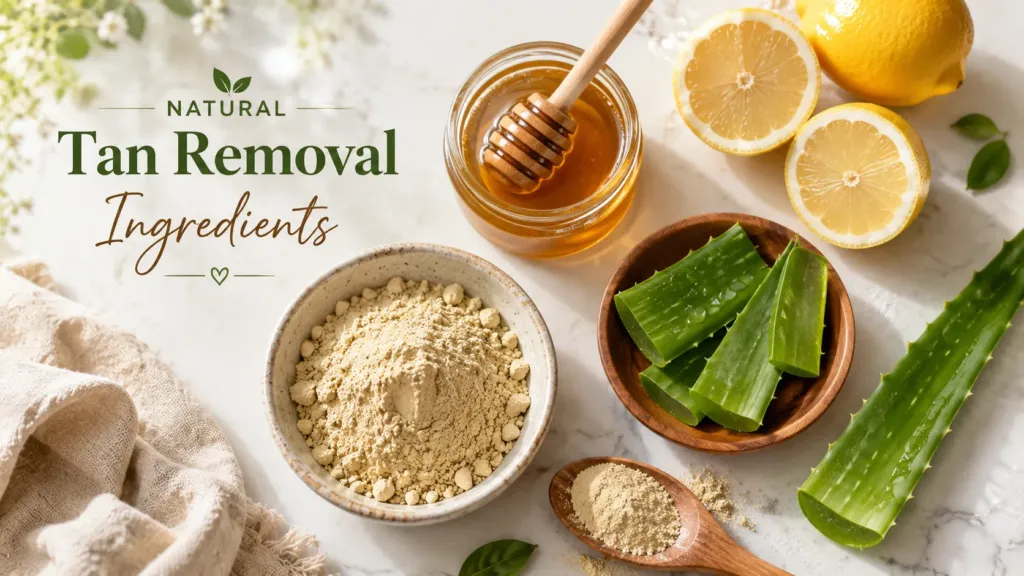
Not everyone wants to reach for chemical-heavy products, and the good news is that some of the most effective tan-removal ingredients are probably already in your kitchen. Here are 12 home remedies for tan removal that work on the face, hands, and body — plus how to use them safely.
Table of Contents
1. Lemon and Honey
Lemon’s citric acid exfoliates tanned skin cells, while honey moisturizes and soothes. Mix equal parts, apply for 10-15 minutes, then rinse. Always follow with sunscreen, since lemon increases sun sensitivity.
2. Multani Mitti and Rose Water
This classic combination absorbs excess oil and gently lifts tan. Make a smooth paste, apply for 15-20 minutes, and rinse before it fully dries.
3. Tomato Pulp
Tomatoes are rich in lycopene, which has natural skin-brightening properties. Rub fresh tomato pulp directly onto tanned areas and leave for 15 minutes before rinsing.
4. Aloe Vera Gel
Fresh aloe vera soothes and hydrates sun-exposed skin while supporting faster cell renewal. Apply straight from the leaf and leave on overnight for best results.
5. Besan (Gram Flour) and Turmeric
A traditional ubtan recipe — mix besan, a pinch of turmeric, and milk or water into a paste. It gently exfoliates while turmeric’s anti-inflammatory properties calm sun-stressed skin.
6. Potato Juice
Potato contains natural enzymes that can help fade pigmentation. Grate a potato, extract the juice, and dab it onto tanned skin with a cotton pad.
7. Cucumber and Yogurt
Cucumber cools and hydrates, while yogurt’s lactic acid exfoliates. Blend both into a smooth paste and apply for 15 minutes — great for sensitive or sun-irritated skin.
8. Papaya Pulp
Papaya contains papain, a natural enzyme that breaks down dead skin cells. Mash ripe papaya and apply as a mask for 15-20 minutes, 2-3 times a week.
9. Sandalwood (Chandan) Paste
Sandalwood has long been used to cool and brighten skin. Mix sandalwood powder with rose water or milk and apply as a mask for a soothing, brightening effect.
10. Coconut Oil Massage
Massaging cold-pressed coconut oil onto tanned areas before a bath can help soften and gradually lighten skin, while also deeply moisturizing.
11. Oatmeal and Milk Scrub
Ground oatmeal mixed with milk makes a gentle exfoliating scrub that’s suitable even for sensitive skin, helping slough off tanned surface cells without irritation.
12. Orange Peel Powder
Dried and powdered orange peel mixed with yogurt or rose water creates a vitamin C-rich mask that helps brighten tanned skin over consistent use.
How to Use Home Remedies Safely
• Always patch test a new remedy on your inner arm before applying to your face.
• Avoid citrus-based remedies (lemon, orange) right before stepping into direct sunlight.
• Limit exfoliating remedies to 2-3 times a week to avoid over-stripping your skin barrier.
• Follow up with a moisturizer and sunscreen, especially after acid- or enzyme-based remedies.
Home remedies work best as a consistent, gentle routine rather than a one-time fix. Most people see visible improvement within 1-2 weeks when these are used a few times weekly alongside daily sun protection.
FAQs
Does lemon and honey really remove tan?
Yes — lemon’s citric acid gently exfoliates dead, tanned skin cells while honey moisturizes and soothes, making it one of the most effective natural combos, though it can sting sensitive skin.
Can multani mitti remove tan permanently?
Multani mitti absorbs excess oil and lightly exfoliates to reduce visible tan, but like all remedies it needs regular use since it doesn’t stop future tanning.
Does aloe vera help with tan removal?
Aloe vera soothes sun-damaged skin and supports faster cell turnover, which helps tan fade quicker, though it works better combined with an exfoliant like besan or oats.
How long do home remedies take to remove tan?
Most natural remedies show visible lightening in 1-2 weeks of consistent use, 2-3 times a week, depending on how deep the tan is.
Are home remedies safe for sensitive skin?
Most are gentle, but citrus-based remedies like lemon can irritate sensitive or broken skin — always patch-test first and follow with sunscreen since lemon increases photosensitivity.
