
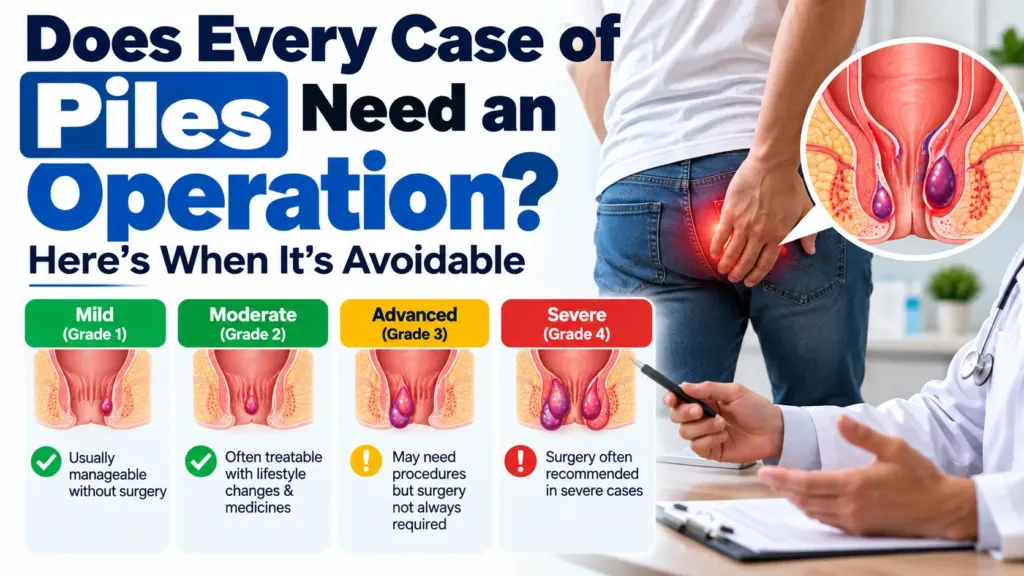
The word “operation” scares people so much that many suffer with piles for years rather than see a doctor. Here’s what most don’t know: the majority of people with piles never need surgery. Diet, habits, medicines and small clinic procedures handle most cases.
So when is an operation really needed? It depends mostly on one thing: the grade of your piles.
Step 1: Know your grade
Table of Contents
Doctors grade internal piles from 1 to 4 (explained fully in internal vs external piles).
| Grade | What happens | Usual treatment |
|---|---|---|
| 1 | Bleeds, stays inside | Diet, fibre, habits, medicines |
| 2 | Comes out on straining, goes back on its own | Same as grade 1; clinic procedures if it persists |
| 3 | Comes out, must be pushed back by hand | Clinic procedures; surgery for some |
| 4 | Stays out, can’t be pushed back | Usually surgery |
Step 2: Try conservative treatment first
For grades 1 and 2, and many grade 3 cases, doctors first recommend 4 to 6 weeks of:
- A high-fibre diet and 8 to 10 glasses of water
- Isabgol or a stool softener
- Warm sitz baths
- No straining; toilet time under 5 minutes
- Creams or tablets for symptom relief (see cream, tablet or ointment)
Many people never need anything more.
Step 3: Non-surgical clinic procedures
If symptoms continue, these quick procedures are usually done in the clinic, often without anaesthesia:
- Rubber band ligation: a tiny band cuts off blood supply to the pile, which shrinks and falls off in about a week. One of the most common treatments for grade 2 and 3 piles.
- Sclerotherapy: an injection that shrinks the pile.
- Infrared coagulation: heat that seals the blood vessels feeding the pile.
- Kshar Karma: an Ayurvedic para-surgical procedure using a herbal alkaline paste, done by trained Shalya Tantra specialists.
Step 4: When an operation is needed
Surgery is usually advised when:
- Piles are grade 4 or large grade 3
- Clinic procedures haven’t worked
- Bleeding is heavy or causes anaemia
- External piles keep clotting
- There are both large internal and external piles
Common types of piles operation
- Hemorrhoidectomy: removes the piles. Most effective long-term, but recovery is more painful (2 to 4 weeks).
- Stapler hemorrhoidopexy: lifts piles back into place. Less pain, but a higher chance of return.
- Laser surgery: shrinks piles with laser energy, with less pain and quicker recovery for suitable cases. Read laser treatment for piles.
- DGHAL: ties off the blood vessels feeding the piles using ultrasound guidance.
Questions to ask before agreeing to surgery
- What grade are my piles?
- Have I tried diet, medicines and clinic procedures long enough?
- Which surgery do you recommend, and why?
- What is the recovery time and chance of return?
- What will the total cost be, including medicines and follow-up?
A good doctor will explain this patiently. If you feel rushed, get a second opinion.
Can piles come back after surgery?
Yes, if the old habits continue. Fibre, water and short toilet visits matter even more after surgery. Wondering whether yours could heal without treatment? Read can piles go away on their own? For the basics, see piles kya hota hai.
Frequently Asked Questions
Is an operation the only cure for piles?
No. Most piles improve with diet, habits, medicines or small clinic procedures. Surgery is mainly for grade 4 or stubborn grade 3 piles.
Which is the best operation for piles?
It depends on your grade and type. Hemorrhoidectomy is most effective long-term; laser and stapler methods offer faster recovery for suitable cases.
How painful is a piles operation?
Traditional surgery can be painful for 1 to 2 weeks. Laser and stapler methods are usually less painful. Pain medicines and sitz baths help.
How long does recovery take after piles surgery?
Most people return to desk work in 1 to 2 weeks after laser or stapler surgery, and 2 to 4 weeks after traditional surgery.
Can piles return after an operation?
Yes, especially if constipation and straining continue. A fibre-rich diet and good toilet habits lower the risk.
About the author: Deepak Sagar is an Ayurvedic wellness content writer with Aarogya Jeevanam and over 6 years of experience writing on digestive health and holistic living.
Disclaimer: This article is for general information only and is not a substitute for medical advice. Please consult a qualified doctor for diagnosis and treatment.