
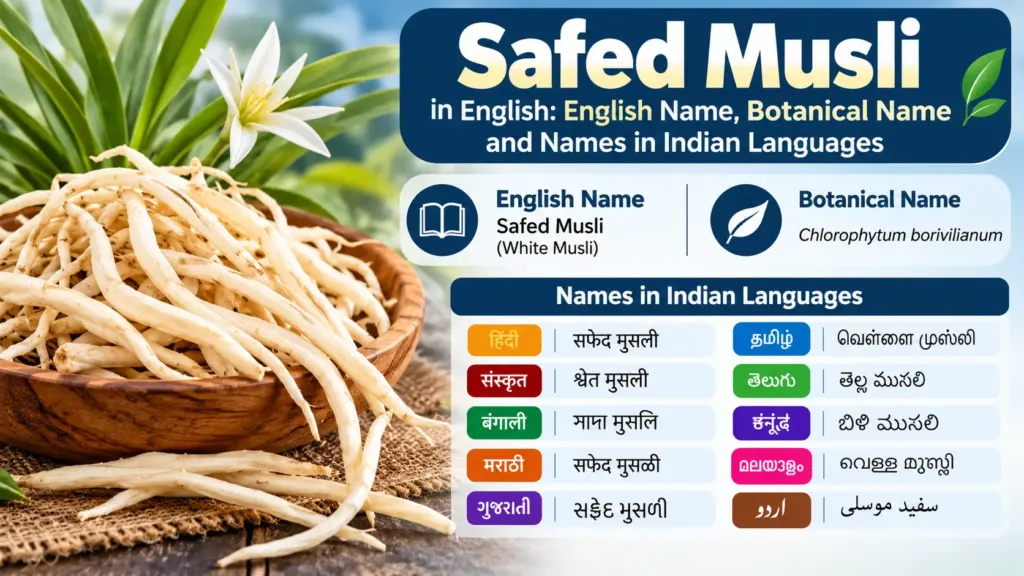
In June 1954, botanists working in the plains around Borivali, then on the edge of Bombay, recorded a small herb with white, star-shaped flowers. When it was formally named, it took the name of the place: Chlorophytum borivilianum. Millions of Indians know it by a simpler name, safed musli. But ask what it is called in English, Tamil or Telugu, and very few can answer.
Quick answer: Safed musli in English is called white musli. Its botanical name is Chlorophytum borivilianum. It is sometimes also sold as “Indian spider plant root”.
Safed musli English name and meaning
“Safed” means white in Hindi, and “musli” comes from the Sanskrit mushali, the classical Ayurvedic name for this group of roots. So the literal English name is simply white musli. In Ayurvedic texts it is also called shweta musali.
Botanical name and classification
| Botanical name | Chlorophytum borivilianum Santapau & R.R.Fern. |
| Family | Asparagaceae (asparagus family) |
| Named after | Borivali, Mumbai, where it was first described in the 1950s |
| Native to | Forests of western and central peninsular India |
| Conservation status | Critically Endangered in the wild (IUCN); commercial supply is farmed |
| Part used | Dried tuberous roots |
A related species, Chlorophytum tuberosum, is also sold as safed musli in some markets. When buying, check that the label names C. borivilianum.
Safed musli in Tamil, Telugu, Marathi, Kannada and more
| Language | Name |
|---|---|
| Hindi | सफेद मूसली (Safed musli) |
| English | White musli |
| Sanskrit | Mushali, Shweta musali |
| Tamil | Taniravi thang |
| Telugu | Tella nela tadi, Swetha musli |
| Marathi | Safed musli, Kulai (कुळई) |
| Kannada | Swetha musli |
| Gujarati | Dholi musli |
| Chhattisgarhi | Khairuwa |
Regional names vary by district, and some names are shared with related Chlorophytum species.
What does the safed musli plant (paudha) look like?
Safed musli is a small herb, about 30–45 cm tall. It has long, narrow leaves that grow from the base and white, star-shaped flowers on a single stalk during the monsoon. Below the soil it forms a cluster of 10–20 finger-like, fleshy white roots. The leaves dry off after the rainy season, and the roots are harvested, peeled and sun-dried. Peeled, dried roots turn off-white to light cream.
Where is it grown?
Today most safed musli is cultivated in Madhya Pradesh, Chhattisgarh, Rajasthan, Gujarat and Maharashtra as a monsoon crop.
What is safed musli used for?
In Ayurveda it is a vitality tonic used for strength, stamina and male reproductive health. A 2013 placebo-controlled study found improved sperm parameters and testosterone in healthy men taking its extract. Read the full list in English: safed musli benefits, or in Hindi: safed musli ke fayde. For dosage and taseer: safed musli khane ka tarika.
FAQs
What is safed musli called in English? White musli.
What is the botanical name of safed musli? Chlorophytum borivilianum.
What is safed musli called in Tamil? Taniravi thang.
What is safed musli called in Telugu? Tella nela tadi, also swetha musli.
Is safed musli the same as musli (cereal)? No. Breakfast muesli is a cereal mix. Safed musli is an Ayurvedic herb root.
Is safed musli the same as kali musli? No. Kali (black) musli is a different plant, Curculigo orchioides.
Sources: Wikipedia, Chlorophytum borivilianum; Nikam & Prakash, Pharmacognosy Reviews 2009; University of Melbourne Multilingual Plant Name Database.