
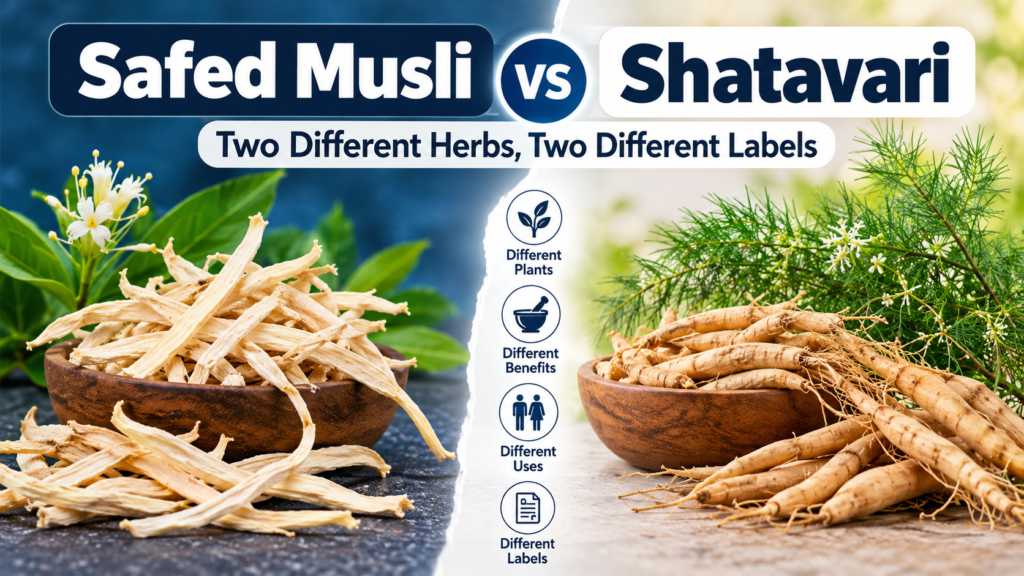
The words “traditional herb” can make two products sound interchangeable. Their botanical names say otherwise.
Safed musli usually refers to Chlorophytum borivilianum, while shatavari is Asparagus racemosus. Names can vary in commerce, so I would use the Latin botanical name on the label to confirm what is actually inside. This matters especially when products combine several herbs.
Also read: Shatavari Benefits: What Is Traditional, and What Is Supported by Research?
Both have histories of traditional use, but traditional use is not the same as strong clinical proof for a specific health outcome. Extracts may also differ in plant part, concentration and testing. A claim about one preparation should not be transferred to another simply because the common name matches.
When comparing products, I check the complete ingredient list, plant part, amount per serving, quality information, warnings and manufacturer contact details. I avoid choosing based only on dramatic claims or testimonials. If I am pregnant, breastfeeding, taking medication or managing a condition, I would ask a qualified health professional first.
Table of Contents
A closer look at safed musli
The first useful comparison is botanical identity: common names can blur two different plants and their different evidence bases.
Related: Safed musli for men
A fair comparison uses the same questions for both options: what plant is it, which plant part is used, what preparation is sold, and what human evidence supports the exact outcome? Traditional history can explain why people are interested, but it does not prove that one is stronger or better for everyone.
I would be cautious with tables that rank herbs without direct head-to-head research. A study on one preparation cannot automatically be carried over to another brand or format. Instead, define the concern first, check safety and medicine interactions, then discuss the specific product with a clinician. The most useful answer may be that the evidence is not strong enough to declare a winner.
My takeaway
My takeaway is not that one option wins for everybody. It is that a careful comparison starts with a defined goal, direct evidence and personal safety, then leaves room for uncertainty where research is still limited.
Related guides on Aarogya Jeevanam
- Shatavari Powder: What to Know Before You Buy It
- Ashwagandha vs Shatavari: How to Compare Them Without Guesswork
- Ashwagandha and Shatavari: What Is Different, and Why Are They Combined?
Sources
Disclaimer: This article is for general information only and is not medical advice. Please consult a qualified healthcare professional before starting any supplement.
Frequently asked questions about safed musli
Are safed musli and shatavari the same?
No. They are different plants. Confirm the botanical name rather than relying only on a common name.
Which one should I choose?
That depends on your reason for considering it and your medical context. Ask a clinician and compare the exact product evidence and label.
