
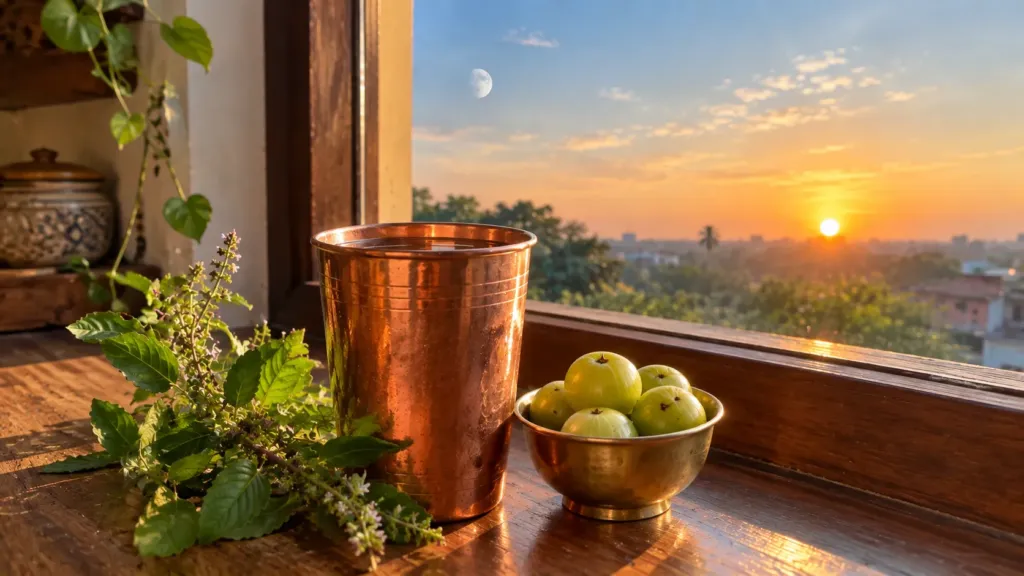
Quick answer: Ayurveda Day 2026 is on Wednesday, 23 September. The national event is in Nagpur, and the theme is “Ayurveda for a Healthier Tomorrow.” At home, you can mark it by starting one small daily habit. That could be a fixed wake-up time, an earlier dinner, or a lighter, seasonal plate. Then keep it going for seven days.
Every year around this time, my inbox fills up with the same kind of message. “Ayurveda Day offer!” “Flat 40% off on immunity kits!” I understand why brands do it. We sell Ayurvedic wellness products too.
Still, I’ve always felt this day deserves better than a discount banner.
Ayurveda, at its heart, was never mainly about products. It was about how you live: when you wake, what you eat and when, how you sleep, and how you adjust as the seasons change. The herbs came second. The daily rhythm came first.
So this year, instead of telling you what to buy, I want to share what I think is the most meaningful way to observe Ayurveda Day. You do it at your own home, in your own kitchen, over one week.
Table of Contents
First, What’s Actually Happening on 23 September?
This is the 11th Ayurveda Day, organised by the Ministry of Ayush. The main national event is in Nagpur, Maharashtra.
For years, Ayurveda Day was celebrated on Dhanvantari Jayanti (Dhanteras), so the date kept shifting. Since 2025 it has been fixed to 23 September. That’s why many people are still searching “when is Ayurveda Day?” If you remembered it as a Diwali-season event, you’re not wrong. It has simply moved.
The theme this year is “Ayurveda for a Healthier Tomorrow” (स्वस्थ भविष्य के लिए आयुर्वेद). The official focus is on evidence-based Ayurveda, research, integrated healthcare, and community wellbeing.
I like that word evidence. It tells me the conversation is maturing. Ayurveda no longer needs to be defended with exaggerated claims. It can be practised honestly, with respect for both tradition and modern science.
The Part Most People Miss: Why Late September Makes Sense
This is the bit I find genuinely beautiful. The new date sits right at the autumn equinox, the point where day and night are roughly equal.
In Ayurveda’s seasonal calendar (ritucharya), this is the start of Sharad Ritu, the autumn that follows the monsoon. It runs roughly from mid-September to mid-November.
Classical texts describe Sharad as the season when Pitta tends to rise. The body has spent months in the damp, heavy monsoon. Then the sun suddenly turns sharp again. Many of us notice the effects without naming them:
- more acidity or heartburn
- irritability
- skin that feels hot or breaks out
- disturbed sleep
I’m not saying this to diagnose anyone. These are traditional descriptions, not medical findings. But as a lens for noticing your own body, I’ve found it surprisingly useful. Ayurveda Day landing right at this seasonal shift feels like a nudge: reset now, before the festive season begins. And Navratri starts on 11 October this year.
My 7-Day Ayurveda Day Routine (23–29 September)
None of this requires special products. Pick all seven, or just the two or three that feel doable. One habit you keep is worth more than seven you abandon by Friday.
Day 1 (23 Sep): Fix your wake-up time
Dinacharya (daily routine) begins with waking at a consistent hour. Don’t aim for 4 AM if you currently wake at 8. Just choose a time and hold it for the week. Start with a glass of room-temperature water. If you want to be part of the official celebration, you can also take the public pledge on ayurvedaday.org.in.
Day 2: Do a Sharad kitchen check.
Traditional autumn guidance favours sweet, bitter and astringent tastes. It suggests going easy on very sour, salty, fried and fiery foods. In real-life Indian terms, that means:
- more lauki, turai, parwal and moong dal
- rice or older grains
- a little ghee
- seasonal fruit
- fewer pakoras, pickles and extra-spicy chutneys
You don’t need to overhaul your diet. Just tilt it. Amla season also begins in autumn. If you’re wondering how much is sensible, I’ve written about how many amla to eat in a day.
Day 3: Move dinner earlier.
This one changed more for me than any herb ever did. Try to finish dinner two to three hours before bed, and keep it lighter than lunch. Ayurveda considers digestive fire (Agni) strongest around midday. Modern sleep research also generally supports not going to bed on a full stomach.
Day 4: Take an evening walk.
Sharad evenings are pleasant in most of North India. Tradition even speaks of the cooling value of autumn moonlight, most famously on Sharad Purnima. A 20-minute walk after dinner is simple, free, and good for you by almost any standard.
Day 5: Protect your sleep window.
Keep the last 30–45 minutes before bed screen-free. If you want a warm drink, plain warm milk with a pinch of haldi or elaichi is the classic Indian choice. Kitchen haldi comes first. A turmeric extract is a separate decision to discuss with your doctor, especially if you have lactose issues or a medical condition.
Day 6: Read your labels.
This is my practical, slightly unglamorous suggestion. Pull out the herbal products already in your cupboard and actually read them. Check four things:
- Does it name the plant and the part used?
- Is there a batch number and expiry date?
- Is there a licence number?
- Are the claims sensible, or does it promise to “cure” things?
For ashwagandha, look for root. That is the part classical texts describe and the one most human studies have used. If a label shouts miracles, that alone tells you something.
Day 7: Talk to someone who knows.
Ask an elder in your family what they ate or did each autumn. Or, if you have a specific health concern, speak to a qualified BAMS doctor or vaidya. You can also start a free consultation with our Ayurveda team. Then note which of this week’s habits felt good, and keep those.
What I’d Honestly Skip
In the spirit of this year’s “evidence-based” theme, here’s what I’d avoid:
- Drinking kadha all day “for immunity.” Kadha is a lovely traditional drink. Overdoing strong spices, though, can aggravate acidity, which is exactly the Sharad problem. It is also not a treatment for dengue or viral fever. If you have a fever this season, please get tested.
- Stopping prescribed medicines in favour of herbs. Ayurveda and modern medicine can work alongside each other. Replacing one with the other on your own is risky.
- Anything sold as a “miracle.” Real Ayurveda is slow, seasonal and personal. It doesn’t need to shout.
Tradition vs Evidence: How I Think About It
I find it helpful to hold two ideas at once.
First, many Ayurvedic principles are thousands of years old and deeply valuable as a way of living. These include regular routines, seasonal eating, early dinners and good sleep. Much of that is also well supported by modern lifestyle research.
Second, specific claims about individual herbs are a different matter. They need specific evidence. Some herbs have promising human studies. Many have only small trials or traditional use.
Being honest about that difference doesn’t weaken Ayurveda. It makes it more trustworthy. That, I think, is what a “healthier tomorrow” really asks of all of us, brands included.
Who Should Be Careful
Please speak to a doctor before changing your diet significantly or starting any herb if any of these apply to you:
- you are pregnant or breastfeeding
- you have diabetes, a thyroid condition, high blood pressure or a liver or kidney condition
- you take regular medication, especially sedatives, blood thinners or thyroid medicine
- the routine is for a child
Frequently Asked Questions
When is Ayurveda Day 2026?
Wednesday, 23 September 2026. The date has been fixed every year since 2025. It no longer follows Dhanteras.
What is the theme of Ayurveda Day 2026?
“Ayurveda for a Healthier Tomorrow” (स्वस्थ भविष्य के लिए आयुर्वेद). The focus is on evidence-based Ayurveda, research, integrated healthcare and community wellbeing.
Where is the main Ayurveda Day 2026 event?
Nagpur, Maharashtra. Activities also take place across India and in many other countries.
Why was Ayurveda Day moved to 23 September?
The old date followed Dhanteras, which shifts every year by several weeks. A fixed date makes national and international participation easier. It also aligns the day with the autumn equinox.
What is the simplest way to celebrate Ayurveda Day at home?
Choose one daily habit and keep it for a week. Good options are a fixed wake-up time, an earlier and lighter dinner, or a more seasonal plate. Small, consistent routines are the core of Ayurveda.
Is Ayurveda Day connected to the autumn season?
Yes, in a meaningful way. 23 September falls at the start of Sharad Ritu. Ayurveda traditionally links this season with rising Pitta and recommends lighter, cooling food habits.
