
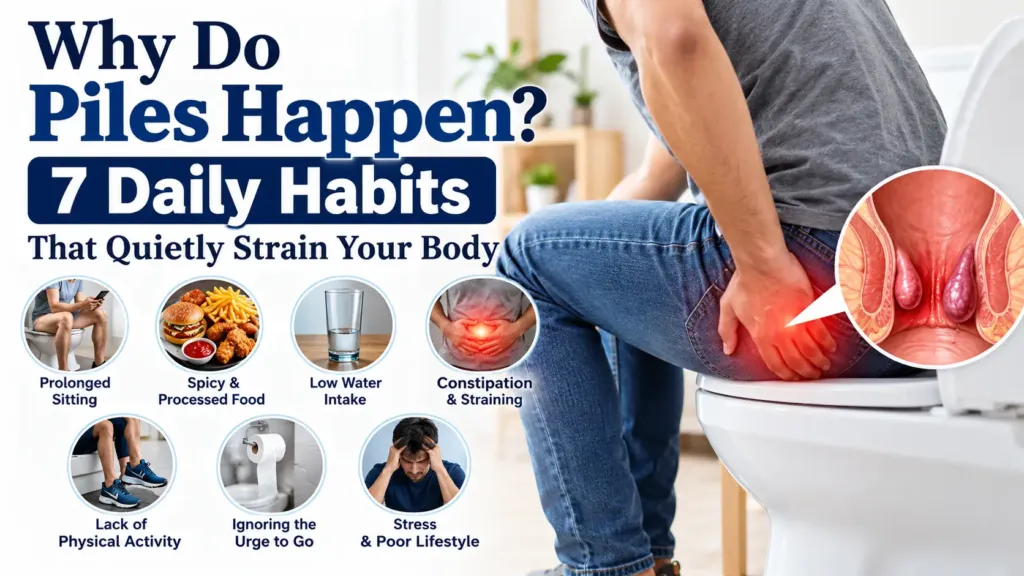
Most people think piles comes from “too much spicy food” or “heat in the body.” The real story is less dramatic and more useful: piles usually builds up slowly from small habits you repeat every single day.
If you already know what piles is, this guide explains the why. Count how many of these seven habits you have.
1. Scrolling on the toilet
A toilet seat gives your lower body no support, so blood collects in the veins around the anus. The longer you sit, the more they swell. A 2025 PLOS One study found people who used phones on the toilet had a 46% higher risk of piles. Over a third of phone users sat for more than 5 minutes, compared with very few non-users.
Fix: Leave the phone outside. Aim for 5 minutes or less.
2. Straining to pass stool
Pushing hard raises pressure inside your abdomen and forces those cushions downward. Done daily, it stretches the tissue that holds them in place.
Fix: Don’t force it. If nothing happens in a few minutes, get up and try later.
3. Eating too little fibre
Maida, biscuits, packaged snacks and white rice make stool small and hard. Hard stool needs more pushing. Most adults need around 25 to 30 grams of fibre a day, and many Indians eat far less.
Fix: Add dal, whole grains, sabzi, fruits and isabgol. See our piles diet guide.
4. Not drinking enough water
Fibre needs water to soften stool. Without it, extra fibre can actually make constipation worse.
Fix: 8 to 10 glasses a day, more in summer or if you sweat a lot.
5. Ignoring the urge to go
Holding stool because you’re busy, travelling or in a meeting lets your colon absorb more water from it. It turns harder and drier by the hour.
Fix: Go when your body tells you to. A morning routine after warm water helps.
6. Sitting for long hours
Desk jobs, long drives and hours on the sofa keep steady pressure on the pelvic veins and slow digestion.
Fix: Stand up and walk for 2 to 3 minutes every hour. A daily 30-minute walk also helps bowel movement.
7. Lifting heavy weight the wrong way
Holding your breath while lifting heavy objects or gym weights creates the same pressure as straining on the toilet.
Fix: Breathe out as you lift, and don’t lift more than you can handle.
Other causes you can’t fully control
- Pregnancy: the growing uterus presses on pelvic veins. Read piles in women.
- Age: the supporting tissue weakens over time.
- Long-term diarrhoea: frequent loose motions also irritate the area.
- Family history: some people simply have weaker tissue.
What Ayurveda adds
Ayurveda sees most of these habits as different roads to the same place: weak digestion (Mandagni) and dry, hard stool from aggravated Vata. That is why gut-friendly routines such as warm water in the morning, regular meal times and ghee in moderation are part of Ayurvedic advice.
Already have symptoms?
Changing these habits helps prevent piles and stops mild piles from getting worse. For soothing relief, try a sitz bath. If you prefer Hindi, read पाइल्स कैसे होता है.
Frequently Asked Questions
What is the main cause of piles?
The main cause is repeated pressure on the veins around the anus, usually from constipation, straining and sitting too long on the toilet.
Does spicy food cause piles?
There is no strong evidence that spicy food causes piles. It can increase burning if you already have piles or a fissure, so reduce it if it bothers you.
Can sitting for long hours cause piles?
Yes. Long sitting, especially on the toilet, increases pressure on the anal veins and slows digestion, both of which raise your risk.
Can young people get piles?
Yes. Piles is increasingly common in people in their 20s and 30s because of low-fibre diets, desk jobs and long toilet time.
How can I prevent piles?
Eat more fibre, drink enough water, don’t strain, go when you feel the urge, limit toilet time to about 5 minutes and stay active.
About the author: Deepak Sagar is an Ayurvedic wellness content writer with Aarogya Jeevanam and over 6 years of experience writing on digestive health and holistic living.
Disclaimer: This article is for general information only and is not a substitute for medical advice. Please consult a qualified doctor for diagnosis and treatment.
Source: Smartphone use on the toilet and the risk of hemorrhoids, PLOS One (2025)