
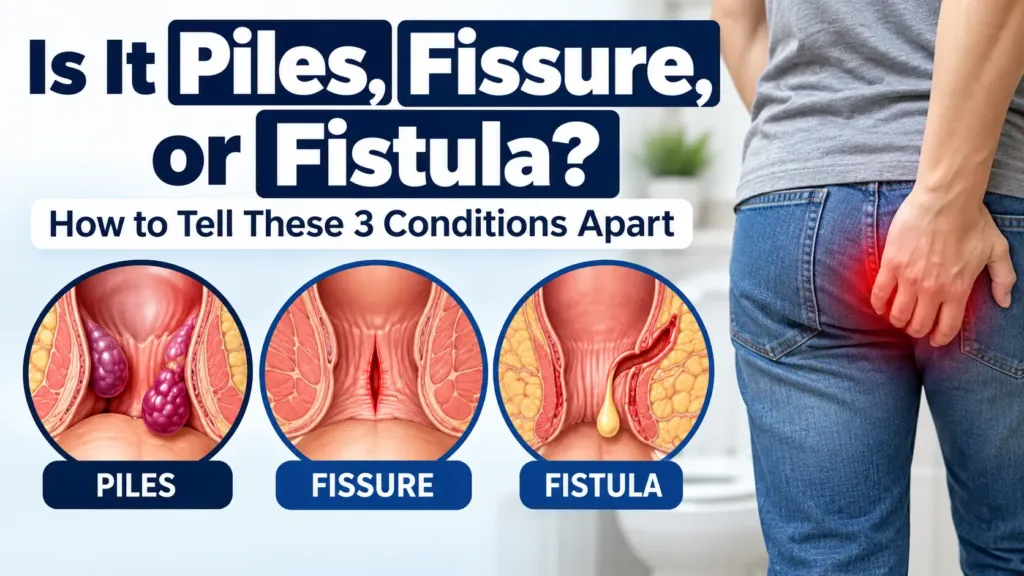
Many people say “mujhe piles hai” for any pain or bleeding in the anal area. But three very different problems live in the same place: piles, fissure and fistula. They feel similar, yet they need different care. Treating a fissure like piles, for example, can keep you in pain for months.
Here is how to tell them apart.
Piles: swollen cushions
Piles are swollen blood vessels in and around the anus (full explanation here).
- Main sign: painless bright red bleeding, or a soft lump near the anus
- Pain: usually mild, unless the pile is external or has a clot
- Feeling: heaviness, itching, or something “coming out” while passing stool
Fissure: a small tear
An anal fissure is a small cut or tear in the skin lining the anus, usually caused by passing hard stool. People often search for it as “fisher piles,” but it is not piles at all.
- Main sign: sharp, cutting pain while passing stool, often described as passing glass
- Pain: can last minutes to hours after you go
- Bleeding: a few drops or a streak of bright red blood
Because it hurts so much, people start avoiding the toilet. That makes stool harder, which tears the skin again. Breaking this cycle with soft stool and warm sitz baths is the first step.
Fistula: a tunnel
An anal fistula is a small tunnel between the inside of the anal canal and the skin outside. It usually forms after an infection or abscess (a pus-filled boil) near the anus.
- Main sign: pus or fluid discharge near the anus, staining underwear
- Pain: throbbing pain and swelling, sometimes with fever
- Pattern: a boil that bursts, heals, and comes back in the same spot
A fistula does not heal with creams or diet alone. It almost always needs a procedure, such as surgery or the Ayurvedic Kshar Sutra method done by a trained surgeon.
Quick comparison
| Piles | Fissure | Fistula | |
|---|---|---|---|
| What it is | Swollen blood vessels | Tear in the skin | Tunnel with infection |
| Pain | Mild or none (more if external) | Sharp, during and after stool | Throbbing, with swelling |
| Bleeding | Common, bright red | Small streaks | Rare; pus is more common |
| Discharge | Sometimes mucus | No | Pus or fluid |
| Common cause | Straining, long toilet sitting | Hard stool | Gland infection or abscess |
| Heals at home? | Mild cases often do | Many acute ones do | No, needs a doctor |
Can you have more than one?
Yes. Piles and fissure often happen together, because both are linked to constipation and straining. That is why searches like “piles and fissure” are so common.
What helps all three
- Keep stool soft with fibre, water and isabgol
- Don’t strain or sit long on the toilet
- Keep the area clean and dry
- Sitz baths for soothing relief
When to see a doctor
See a doctor if pain is severe, a fissure has lasted more than 6 weeks, you have pus or fever, or you notice heavy bleeding. Learn the bleeding warning signs in blood in stool: when to worry, and the difference between pile types in internal vs external piles.
Frequently Asked Questions
What is the difference between piles and fissure?
Piles are swollen blood vessels and are often painless. A fissure is a small tear that causes sharp pain during and after passing stool.
Is fisher and fissure the same?
Yes. “Fisher” is a common misspelling of fissure, which is a small tear in the anal skin.
Can a fissure turn into a fistula?
Usually not. Fistulas mostly form after an anal gland infection or abscess, not from a fissure. Still, any long-lasting pain or discharge should be checked.
Can fistula be cured without surgery?
Most fistulas need a procedure such as surgery or Kshar Sutra therapy. Medicines may ease symptoms but rarely close the tunnel.
Which is more painful, piles or fissure?
A fissure is usually more painful. Piles are often painless unless they are external or have a blood clot.
About the author: Deepak Sagar is an Ayurvedic wellness content writer with Aarogya Jeevanam and over 6 years of experience writing on digestive health and holistic living.
Disclaimer: This article is for general information only and is not a substitute for medical advice. Please consult a qualified doctor for diagnosis and treatment.