
A reader wrote to me recently with a simple, heartfelt question. Her periods had become irregular and painful, and a relative had suggested ashoka. Should she try ashoka capsules? I wish every question came with such a clear context, because women’s health is personal and varies a great deal. My answer was careful: ashoka has a long traditional place in women’s wellness in Ayurveda, but it is not a replacement for a gynaecologist’s review. This article explains that position, and how I would approach ashoka capsules for women in India.
If your periods are very heavy, painful, irregular, or accompanied by bleeding between cycles, see a doctor. Any bleeding after menopause also needs medical evaluation.
Table of Contents
What ashoka is traditionally used for
Ashoka, scientifically Saraca asoca, is a tree whose bark appears in many traditional women’s health formulas. Ayurvedic texts describe it as supportive of the uterus and general female wellness. These are traditional uses, and they should be read as historical context rather than proof. The bark is strong, and I always suggest respecting it with a clear dose and a doctor’s advice.
Reading an ashoka label
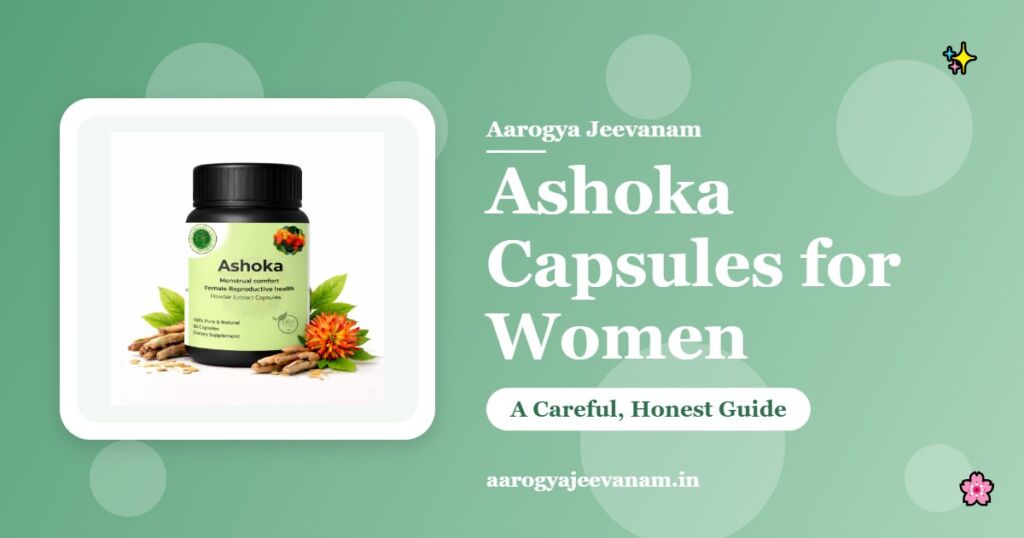
I check the botanical name, which should be Saraca asoca, the capsule count and the daily dose. The ashoka product on Aarogya Jeevanam is a 30-capsule pack of vegetarian capsules, listed at Rs 599 against an MRP of Rs 1,099. Read the directions on the pack. If the seller makes claims about regulating periods or treating infertility, I would step away, because those are medical claims and not appropriate for a supplement.
Ashoka Herbal Capsules (30 Veg Capsules)
Rs 599 Rs 1,099
Traditional ashoka in vegetarian capsules. Check with your doctor before use.
Who should not start without advice
Pregnant women should not use ashoka capsules unless a doctor advises it. Women who are trying to conceive, breastfeeding, or managing a hormonal or gynaecological condition should talk to a doctor first. Teenagers, women with irregular cycles, and anyone on hormone medicines should also get professional advice before starting.
Understanding irregular cycles before you try any herb
Irregular periods have many causes, including stress, thyroid changes, hormonal imbalance, significant weight change, and some medicines. Because the causes are so varied, I always encourage women to track their cycles for at least three months before deciding on a remedy. Note the start and end dates, the flow, any pain and any other symptoms, such as acne, hair changes or fatigue. This record is far more useful to a gynaecologist than a general description, and it can show whether a problem is recurring. A traditional herb can be discussed alongside medical tests, but the tests come first when the pattern is unclear or the bleeding is heavy.
I also remind readers that pain or bleeding that suddenly changes is not a matter for trial and error. Heavy bleeding that soaks a pad every hour, bleeding after sex, bleeding between cycles or any bleeding after menopause should be seen by a doctor promptly.
Talking to a gynaecologist about traditional herbs
Many women feel hesitant to mention herbs during a consultation, but doctors appreciate the information. Bring the product label, the dose you intend to take, and any other supplements or medicines you use. Be honest about how long you have had the symptom and what you have already tried. Ask whether the herb is safe with your current treatment and how long you should wait before reviewing the effect. If the doctor recommends tests, such as an ultrasound or hormone panel, follow through, because they can rule out conditions that herbs cannot address. A respectful, open conversation is the best way to combine traditional knowledge with modern care.
Keeping a cycle diary that actually helps
A simple diary can be a notebook or a phone app. Record the first day of bleeding, the number of heavy days, any pain and its severity, mood changes, sleep quality and stress levels. Add any new product or medicine with the date you started it. After three cycles, look at the pattern. Many women discover a link between stress, travel and irregular cycles that they had not noticed. This record gives your doctor a clear picture and helps you judge whether a traditional approach is making a difference over time.
It is also worth remembering that irregular cycles can be a sign of a condition that needs treatment, and early evaluation often makes that treatment simpler. A traditional herb should never delay a visit that a doctor would normally recommend for the same symptom.
Finally, be patient with your body. Cycles can take a few months to settle after a change in routine, stress or medicine, so judge a trial over several cycles rather than one.
Frequently asked questions
Can ashoka help with heavy bleeding?
Do not use any herb to manage heavy bleeding on your own. Heavy or unusual bleeding needs a medical evaluation first, so that the cause can be found and treated safely.
Is ashoka safe for women with PCOS?
Women with PCOS or other hormonal conditions should discuss any herbal product with their doctor before starting, because hormonal conditions need individual care and monitoring.
Can ashoka capsules regulate my periods?
I cannot make that claim. If your cycles are irregular, the right step is a check-up and tests with a gynaecologist. Traditional herbs may be discussed alongside that care, but they do not replace it.
Is ashoka safe for long-term use?
Long-term use should be reviewed by a doctor. Stop and seek advice if you notice unusual bleeding, pain, or any other new symptom.
Can I take ashoka with other women’s health supplements?
Check for overlapping herbs and ask your doctor, particularly if you use hormone medicines or supplements containing iron, calcium or other active ingredients.
How long should I try ashoka before I decide?
Keep a cycle diary and discuss it with your doctor after two to three cycles. Do not make decisions based on a single month.
My final word
Ashoka has a respected place in traditional women’s wellness, but it works best when it sits inside medical care. Use the label, respect the dose, keep a diary, and see a gynaecologist for any persistent or worrying symptom. That is the honest approach I would want for my own family.
Disclaimer: This article is for general information and does not diagnose, treat, cure or prevent any gynaecological or hormonal condition. The product is not a medicine. Consult a qualified doctor before use, especially if you are pregnant, trying to conceive, breastfeeding, or taking medicines.